At https://luckyvibecasino-australia.com/, different gaming worlds meet and combine into a coherent whole. Games with Hold-and-Win mechanics also take an important place in the current portfolio. Available bonus funds can be used in most game categories of the casino. Tutorials and videos in the help section make the start easier for newcomers. The minimum deposit often already starts at 10 units, so casual players can also easily get started. Players have a right to data disclosure and correction at any time in accordance with the GDPR. Special formats such as Speed Roulette accelerate the game pace for impatient players. The mobile cashier is just as clear and orderly as the desktop version. Slot reviews offer detailed insights into the mechanics and payout structures of new titles. The typographic design ensures good readability even at smaller text sizes. The casino proves that modern gambling platforms can offer more than just slot machines.
The 10 Most Popular Defenses
Interactive breakdowns of the defensive schemes that shape college basketball. Click any defense below, then step through its principles on the court.
01
Man-to-Man
1-on-1
Accountability
Universal
The foundation of all college basketball defense. Each defender is assigned one offensive player and is responsible for staying between their man and the basket. Simple in concept, demanding in execution — it requires effort, discipline, and pride on every possession.
Offense
DefenseBall
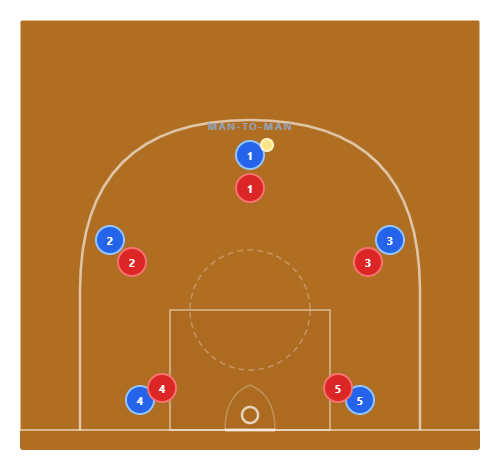
Man Alignment : Each defender mirrors their offensive assignment, staying between the man and the basket. On-ball defender (X1) is in a low stance with an arm’s length gap. Off-ball defenders are “on the line, up the line” — positioned between the ball and their man.
Offense
DefenseBall
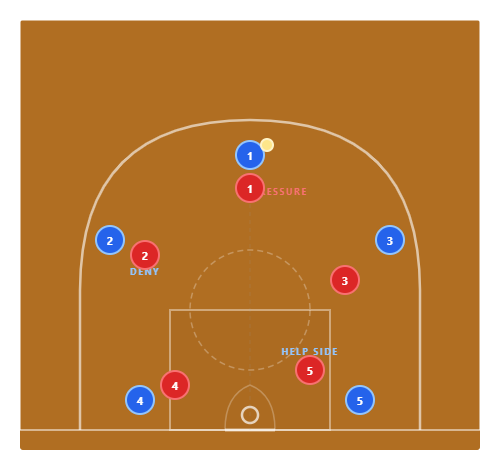
Ball-You-Man Triangle :X1 pressures the ball. X2 is one pass away — in a deny position, hand in the passing lane. X3 and X5 are two passes away — they sag toward the paint in “help position,” able to see both the ball and their man. This ball-you-man triangle is the foundation of all man defense.
Offense
DefenseBall
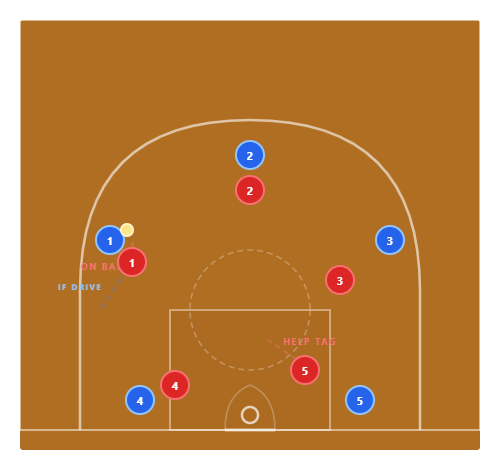
Help & Recover : When the ball moves to the wing, the defense rotates. X1 is now on-ball. X5 sinks to help position and is ready to “tag” (step into the lane) if 1 drives. X3 sags off the weak-side wing. The entire defense shifts as a unit — connected by communication and positioning.
Offense
DefenseBall
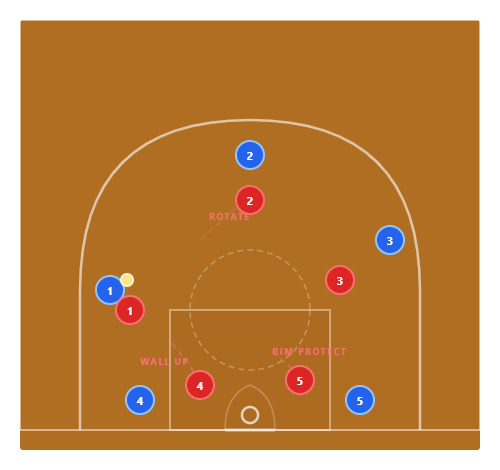
Rotation on Penetration : When 1 drives baseline, the help defense activates. X4 walls up at the block. X5 drops to protect the rim. X2 rotates down to cover X4’s man. X3 sinks to cover X5’s man. This is the defensive chain — one player helps, everyone else rotates to fill the gaps.
1
Ball Pressure
Constant pressure on the ball — hand in the face, active feet
2
Deny & Help
One pass away = deny. Two passes away = help side
3
Communication
Call screens, switches, and help before they happen
4
Closeouts
Sprint 75%, chop-step the last 25%, hand up
Who Runs It
Every program uses man-to-man as their base defense. Kansas under Bill Self, Duke, and UConn are known for elite man-to-man principles.
Best Against
Versatile against everything. Particularly effective against teams that rely on one or two star players — you can put your best defender on their best player.
Weakness
Vulnerable to great individual scorers, ball screens, and teams with elite spacing. Requires all five defenders to play with effort and discipline every possession.
02
Pack Line Defense
Virginia Style
Shrink Floor
No Paint Touches
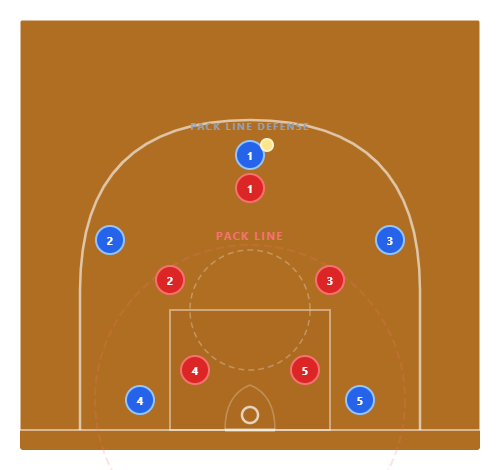
Tony Bennett’s signature at Virginia. All four off-ball defenders position themselves inside an imaginary “pack line” 16 feet from the basket, clogging driving lanes and forcing the offense to shoot contested jumpers over a wall of bodies.
Offense
DefenseBall
The Pack Line : An imaginary arc roughly 16 feet from the basket. All four off-ball defenders stay INSIDE this line. The paint is packed with bodies — there are no driving lanes. The on-ball defender pressures normally, but the four helpers create a wall that dares the offense to shoot over the top.
Offense
DefenseBall
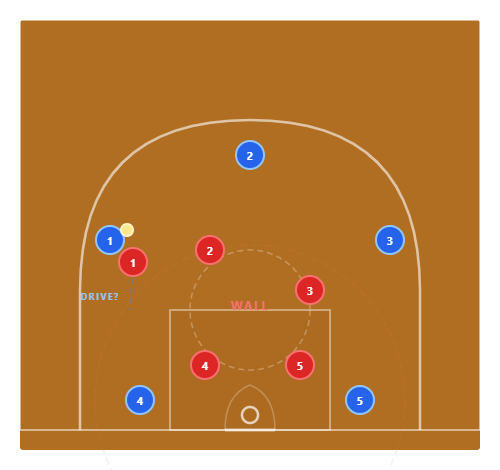
Deny the Drive :When 1 tries to attack off the wing, they see a wall of defenders inside the pack line. X2, X3, X4, and X5 are all in the driving lane already. There’s nowhere to go. The ball handler has two choices: pull up for a contested long two, or pass. Both are what the defense wants.
Offense
DefenseBall
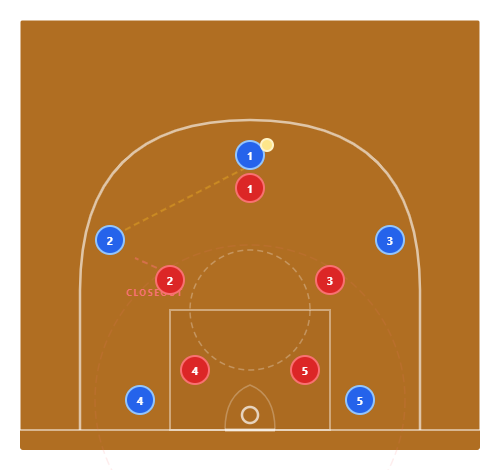
Closeout & Recover : When the ball is passed to the wing, X2 closes out from the pack line — sprint, chop-step, hand up. After contesting, X2 forces the ball handler toward the baseline where help is waiting. The other three defenders stay packed, ready to help if the closeout is beaten.
Offense
DefenseBall
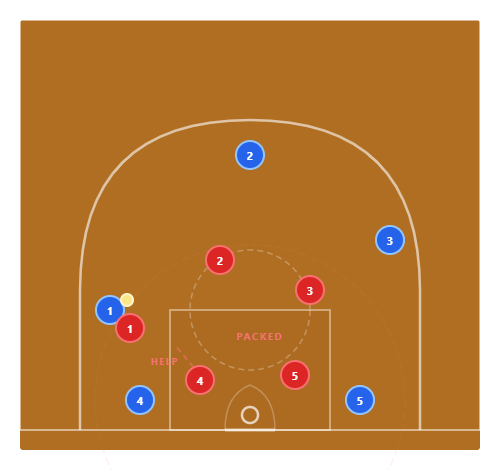
Paint Protection : Even when 1 gets past X1, the help is immediate — X4 is already in the lane. X5 is already near the rim. There’s no easy layup because the help defenders didn’t have to travel far. Virginia consistently ranks top-5 nationally in opponent 2-point FG% because of this principle.
1
Pack Line
Off-ball defenders stay inside the imaginary 16-foot line
2
No Gaps
No driving lanes — the paint is packed with bodies
3
Contest
Closeout and contest every perimeter shot
4
Tempo
Slow the game down — fewer possessions = fewer points
Who Runs It
Tony Bennett's Virginia is the gold standard — a national title in 2019 built on Pack Line. Many programs have adopted elements: Texas Tech, several ACC schools.
Best Against
Destroys teams that rely on dribble penetration and paint touches. Forces the opponent into contested mid-range and three-point shots.
Weakness
Vulnerable to elite three-point shooting teams. By sagging off the arc, the pack line concedes open threes if closeouts are late. Also susceptible to great passing teams.
03
2-3 Zone
Zone
Paint Protection
Rebounding
The most common zone defense in college basketball. Two defenders guard the perimeter, three protect the paint and baseline. It takes away the interior game and forces the offense to beat you from the outside.
Offense
DefenseBall
Base Alignment : X1 and X2 are the two “top” defenders — they cover the perimeter from the wing to the top of the key. X3, X4, and X5 form the baseline trio — X3 and X5 take the wings/baseline, X4 anchors the middle and protects the rim. Each defender owns an area, not a player.
Offense
DefenseBall
Ball-Side Shift :When the ball goes to the left wing, the entire zone shifts left. X1 closes out to the ball. X2 slides to cover the top. X3 drops to the baseline corner area. X4 shifts to the ball-side block. X5 stays weakside. The zone moves like water — always flowing toward the ball.
Offense
DefenseBall
Ball Reversal Response : When the ball swings to the right side, the zone flows right. X2 closes out. X5 slides to cover the right baseline. X4 shifts to the right block. The zone must shift faster than the ball — that’s why quick ball reversal is the zone’s greatest enemy.
Offense
DefenseBall
High Post Collapse : The 2-3 zone’s biggest weakness: the high post. When an offensive player flashes to the free-throw line, both X1/X2 and X4 must decide who covers. If the ball gets there, the zone collapses — creating open shooters on the perimeter. Great 2-3 zones have X4 aggressively challenging the high post catch.
1
2 Up, 3 Back
Two guards up top, three across the baseline
2
Shift
The entire zone shifts toward the ball as a unit
3
Active Hands
Deflections create turnovers — hands in passing lanes
4
Rebound
Zone = box-out by area, not by man. Crash the glass.
Who Runs It
Syracuse under Jim Boeheim made the 2-3 zone famous — running it almost exclusively for 40+ years. Many teams use it situationally.
Best Against
Teams that struggle shooting from outside. The 2-3 zone dominates the paint and forces contested perimeter shots. Also effective against poor passing teams.
Weakness
High post flash, short corner action, skip passes, and elite three-point shooting all crack the 2-3. Quick ball reversal exploits the zone's shifting speed.
04
1-3-1 Zone
Aggressive
Trapping
Turnover Machine
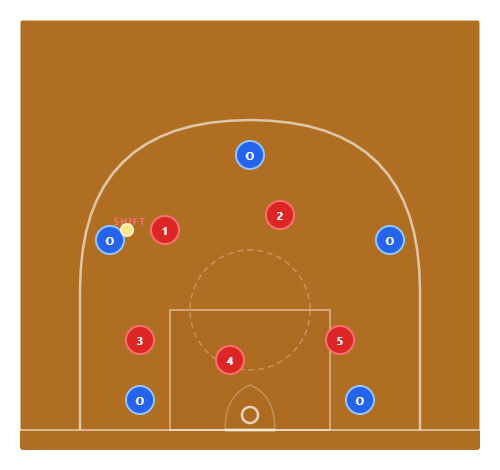
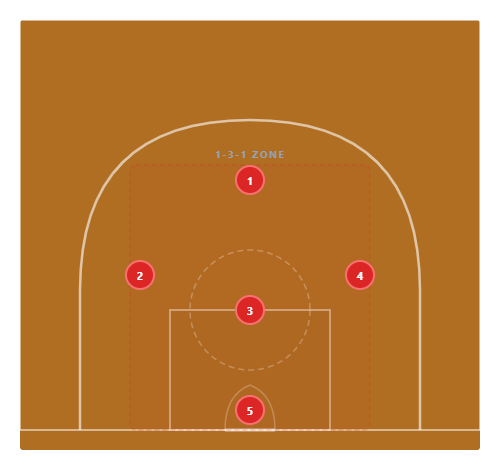
An aggressive, trapping zone that creates chaos. One chaser on top, three across the wings, one baseline anchor. The 1-3-1 excels at trapping the sidelines and forcing turnovers, but it gambles — the corners are wide open if the offense finds them.
Offense
DefenseBall
Diamond Shape : X1 is the “chaser” — they contain the ball and funnel it sideline. X2 and X4 are the wing traps — they spring on the ball when it reaches their side. X3 is the “interceptor” in the middle — they read passing lanes and deflect. X5 is the baseline anchor — they protect the rim and cover corner-to-corner.
Offense
DefenseBall
Sideline Trap :X1 forces the ball handler toward the left sideline. As soon as the ball reaches the wing area, X2 attacks from below — creating a two-man trap on the sideline. The ball handler is pinned between two defenders, the sideline, and the half-court line. Panic sets in.
Offense
DefenseBall
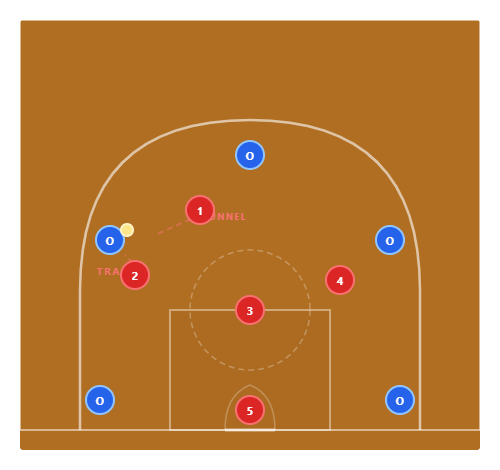
Rotation Behind the Trap : While X1 and X2 trap, the other three rotate aggressively. X3 slides up to deny the pass back to the top. X4 covers the right wing. X5 cheats to the ball-side corner. Every passing lane is challenged — the offense has to throw over or through the defense. That’s where steals happen.
Offense
DefenseBall
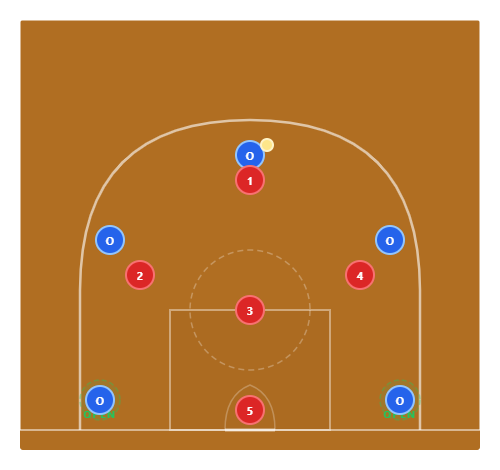
The Gamble — Corners : The 1-3-1’s fatal flaw: both corners are wide open. X5 can only cover one corner at a time. If the offense swings the ball quickly to a corner shooter, there’s no help. Teams that handle pressure and find the corners will torch this defense with open threes.
1
Funnel
The top defender funnels the ball handler to a sideline
2
Trap
Once on the sideline, the wing defender springs a trap
3
Rotate
Remaining 3 defenders rotate to cover passing lanes
4
Gamble
High risk, high reward — live turnovers, but open corners
Who Runs It
West Virginia under Bob Huggins was known for the "Press Virginia" 1-3-1. VCU's "Havoc" system uses 1-3-1 principles. It's a high-energy, change-of-pace defense.
Best Against
Young point guards, poor ball-handling teams, and teams that struggle against pressure. Creates turnovers in bunches and momentum swings.
Weakness
Corners are exposed. Patient teams that can reverse the ball quickly will find open three-point shots. Also vulnerable to teams with a strong high-post passer.
05
3-2 Zone
Zone
3PT Denial
Extended
Three defenders across the arc, two down low. Designed specifically to take away the three-point shot. In an era where college teams shoot 25+ threes per game, the 3-2 zone forces the offense to beat you inside — often their weaker option.
Offense
DefenseBall
3-2 Alignment : X1, X2, and X3 stretch across the three-point arc. They own the perimeter — their job is to contest every catch and deny open threes. X4 and X5 anchor the paint on the blocks. This is a perimeter-first defense — protect the arc, live with mid-range and contested interior shots.
Offense
DefenseBall
Perimeter Pressure :When the ball is on the wing, X1 closes out aggressively — hand up, forcing baseline. X2 slides to cover the top of the key. X3 sinks slightly toward the ball. The three perimeter defenders stay connected on the arc, preventing any open three-point looks.
Offense
DefenseBall
The Weakness — Corners : When the ball gets below the free-throw line extended, the 3-2 struggles. The two low defenders must cover the entire baseline and both corners — too much ground. Smart offenses put players in the corners and short corners to exploit the gaps between X4/X5.
Offense
DefenseBall
Interior Collapse : When the ball enters the high post, both X4 and X5 collapse to contest. This protects the interior but leaves the corners and baseline wide open. The 3-2 lives and dies on its ability to contest threes while keeping the paint protected — a constant balancing act.
1
3 Across
Three defenders cover the arc — deny the three
2
2 Low
Two bigs protect the paint and the blocks
3
Closeouts
Arc defenders close out aggressively on shooters
4
Force Inside
Dare the offense to score inside your big men
Who Runs It
Teams facing elite shooting lineups will deploy the 3-2 situationally. Syracuse has used it alongside their 2-3. It's a matchup-dependent tool rather than a primary defense.
Best Against
Three-point-dependent offenses and teams with weak interior players. If the offense can't score inside, the 3-2 takes away their strengths.
Weakness
Corners, short corners, and the baseline. Only two defenders cover the entire paint. Teams with strong post players will exploit the size disadvantage down low.
06
Matchup Zone
Disguised
Zone Rules Man Principles
Versatile
The best of both worlds — starts in a zone formation but defenders match up to the nearest offensive player as the ball moves. The offense can’t tell if it’s man or zone, which makes it nearly impossible to attack with a set plan. The ultimate disguise defense.
Three defenders across the arc, two down low. Designed specifically to take away the three-point shot. In an era where college teams shoot 25+ threes per game, the 3-2 zone forces the offense to beat you inside — often their weaker option.
Offense
DefenseBall
Initial Look : The matchup zone starts in a 2-3 or 1-2-2 zone formation — but as the offense moves, each defender matches up to the nearest player. From the offense’s perspective, it looks like man-to-man. But when they try to run man offense (screens, cuts), the defense responds with zone rules.
Offense
DefenseBall
Ball-Side Match :When the ball goes to the left wing, X2 matches up to the ball handler — just like man defense. X1 slides to cover the top. But here’s the key: X2 doesn’t follow this player everywhere. X2 owns this AREA. If the ball handler passes and cuts through, X2 stays in the zone and picks up the next player who enters.
Offense
DefenseBall
Bump & Pass : When the point guard cuts through the zone, X1 “bumps” them — stays with them briefly — then “passes” them to X4 as they enter the low zone area. X1 then picks up whoever fills the top. This bump-and-pass principle prevents cuts from creating open looks while maintaining zone integrity.
Offense
DefenseBall
The Confusion Effect : The offense tries zone offense (overload, skip passes) — but each defender is matched up, so the zone gaps don’t exist. They try man offense (screens, PnR) — but the defense uses zone rules to avoid screens. Neither playbook works. The matchup zone forces the offense to freelance, which leads to rushed shots and turnovers.
1
Disguise
Looks like zone on one possession, man on the next
2
Match Nearest
Each defender guards whoever enters their zone area
3
Bump & Pass
When players cut through, defenders "bump" them to the next zone
4
Confusion
The offense can't run zone offense OR man offense confidently
Who Runs It
Jim Larranaga at Miami has been a master of the matchup zone. Many coaches use it as a change-of-pace look to confuse opposing offenses mid-game.
Best Against
Teams that are well-prepared for either man OR zone but struggle when they can't identify which they're facing. Disrupts scouting reports.
Weakness
Difficult to teach — requires high IQ defenders. Also, great passers who can read the defense in real-time will find the soft spots regardless of the disguise.
07
Full-Court Press
Pressure
Tempo
Turnovers
Pick up the offense at the baseline and pressure them for 94 feet. The full-court press aims to speed up the game, force turnovers, and exhaust the opponent. It requires elite conditioning and a deep bench, but when it works, it’s suffocating.
Offense
DefenseBall
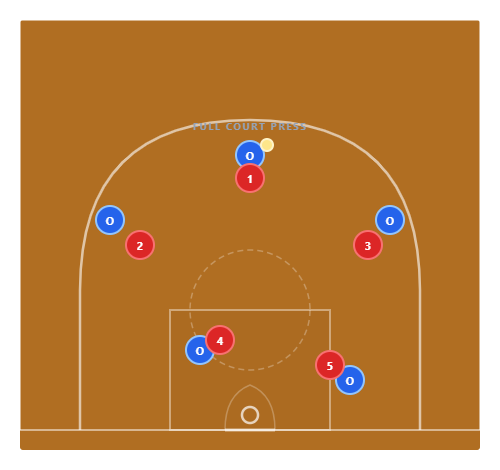
Full Court Engagement : As soon as the opponent scores, the defense picks up man-to-man at the baseline. Every pass is contested, every dribble is pressured. The inbounder is denied. The ball handler is forced to work for every inch of court. The goal: make 10 seconds feel like 5.
Offense
DefenseBall
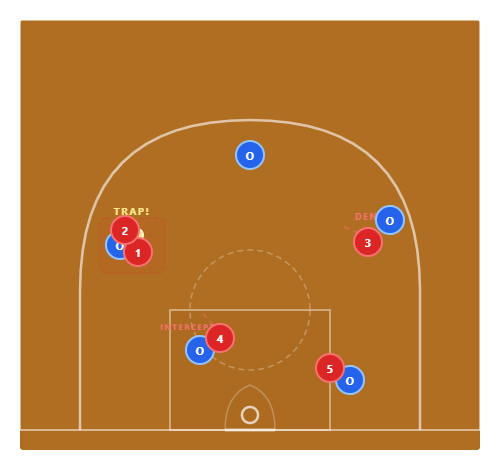
Sideline Trap :X1 funnels the ball handler toward the sideline. X2 sprints from behind to trap — now it’s 2-on-1 with the sideline as a third defender. X4 reads the trap and jumps into the most likely passing lane. X3 denies the reversal pass. The ball handler is surrounded with no easy escape.
Offense
DefenseBall
Passing Lane Denial : The three non-trapping defenders don’t guard their man — they guard the passing lanes. X4 jumps into the lane between the ball and the nearest outlet. X3 denies the middle of the floor. X5 shades toward the ball-side deep outlet. If the trapped player throws a lob or a lazy pass, it’s a steal and a fast break.
Offense
DefenseBall
Fall Back : If the press is broken, the defense must instantly transition to half-court man-to-man. No pouting, no jogging — sprint back, find your man, and defend. A broken press without recovery means an easy layup. The best pressing teams score off turnovers AND defend when the press is beaten.
1
94 Feet
Defend the entire court — no free possessions
2
Trap
Force the ball into corners and sideline traps
3
Rotate
Deny the easy escape pass — cover passing lanes
4
Depth
Requires 8-10 players — the press runs on fresh legs
Who Runs It
Nolan Richardson's "40 Minutes of Hell" at Arkansas is the archetype. VCU's "Havoc" under Shaka Smart. West Virginia under Bob Huggins. All press-heavy programs.
Best Against
Inexperienced ball handlers, teams with poor decision-making under pressure, and opponents with shallow benches who will fatigue from the constant pressure.
Weakness
Requires extreme conditioning and depth. Great ball handlers and patient teams will break the press consistently, creating fast-break layups going the other way.
08
Switching Defense
Versatile Lineup
No Screens
Modern
The modern answer to the ball-screen era. Instead of fighting through screens, defenders switch every screen — trading assignments on the fly. Requires all five players to be able to guard multiple positions, but eliminates the screen-and-roll advantage entirely.
Offense
DefenseBall
The Premise : In a switching defense, all five defenders must be capable of guarding all five positions. When an offensive player screens, the two defenders involved simply trade assignments — no fighting over, no hedging, no recovering. Clean, simple, effective. But it demands a special roster.
Offense
DefenseBall
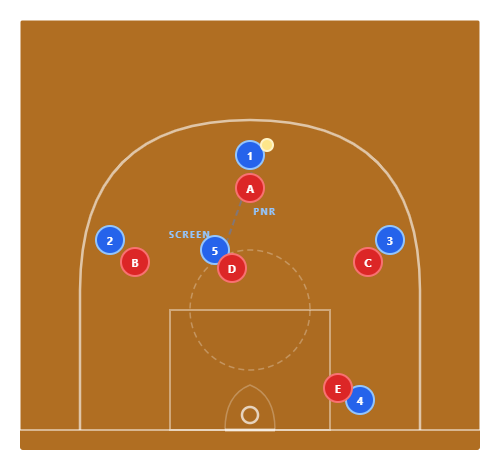
Ball Screen — Before :The 5-man sets a ball screen for the 1. In a traditional defense, this creates a 2-on-1 advantage. The screener’s defender (D) must hedge, recover, or go under — all of which create brief openings. In a switching defense, the response is simpler.
Offense
DefenseBall
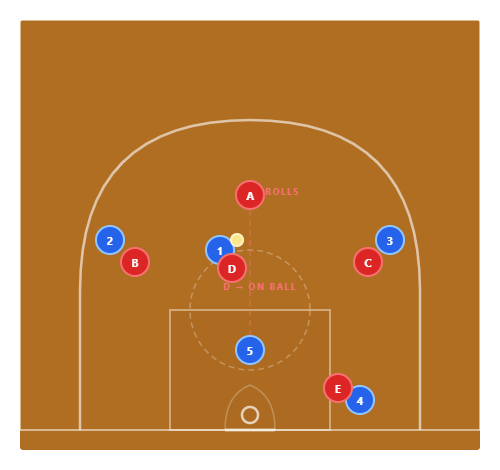
The Switch : D switches onto the ball handler (1). A switches onto the roller (5). No gap, no confusion, no advantage. The screen is completely neutralized. D must be able to guard the point guard on the perimeter. A must be able to guard the big at the rim. If they can, the PnR is dead.
Offense
DefenseBall
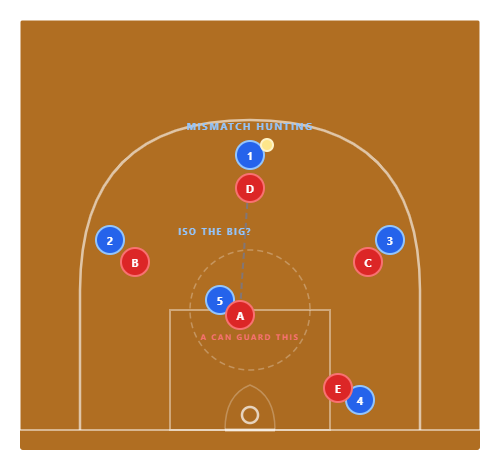
Mismatch Prevention :The offense will try to hunt the switch — isolating the guard (1) against the big defender (A). In switching defenses, “A” MUST be able to guard on the perimeter. This is why switching defenses require positionless, versatile defenders. If A can contain the drive, the mismatch doesn’t exist.
1
Switch All
Every screen triggers a switch — no exceptions
2
Versatility
All 5 defenders must guard 1-through-5
3
Communication
"Switch!" must be called early and loud
4
No Mismatches
If everyone can guard everyone, there are no mismatches to hunt
Who Runs It
Baylor under Scott Drew used switching principles to win the 2021 title. Houston under Kelvin Sampson. Texas Tech. Any team with versatile, athletic defenders.
Best Against
Ball-screen-heavy offenses and pick-and-roll teams. If every screen is switched cleanly, the PnR generates zero advantage.
Weakness
Requires a rare roster — all five players must guard all positions. A true 7-footer or a very small guard can be exploited in switches. Also vulnerable to great post-up players who can isolate a guard switch.
09
Junk / Box-and-1
Star Stopper
Box-and-1
Triangle-and-2
When the opponent has one dominant scorer, you send a dedicated “chaser” to shadow them everywhere while the other four play zone. The Box-and-1 and Triangle-and-2 are designed to neutralize a star player while still protecting the paint. Unorthodox and effective.
Offense
DefenseBall
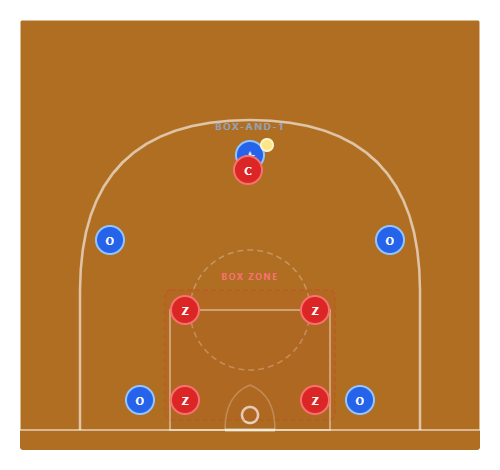
Box-and-1 : One defender (C) is assigned to “chase” the star player (★) everywhere — through screens, around the court, into the locker room if necessary. The other four defenders form a box zone protecting the paint. This neutralizes the star while keeping the interior covered.
Offense
DefenseBall
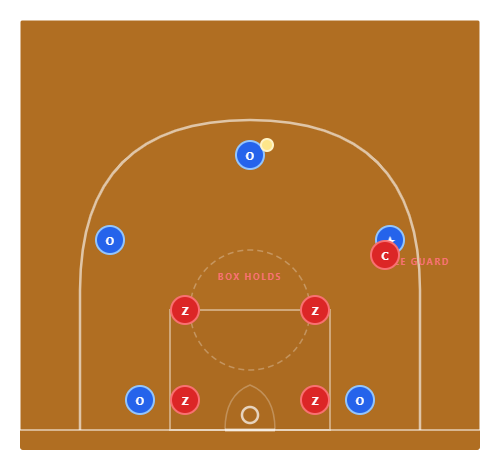
Deny the Star :When the star moves to the wing, the chaser follows — face-guarding, denying the catch, making every touch uncomfortable. The four box-zone defenders ignore the star entirely and protect the paint. The message to the other four offensive players: “You beat us. We don’t think you can.”
Offense
DefenseBall
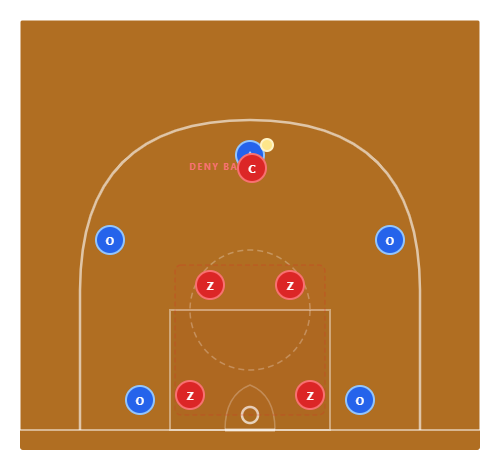
Star Has the Ball : Even when the star catches it, the chaser is all over them — no breathing room. The box zone sags and protects the rim, so the star can’t drive without running into a wall. They’re forced to shoot a contested jumper or give the ball up. If they pass, the chaser re-denies immediately.
Offense
DefenseBall
The Gamble Exposed :The box zone is only four players — it has gaps. When the ball goes to the wing, the zone shifts, but there aren’t enough bodies to cover everything. A great passer can find the open man. That’s the risk: you’re betting the role players can’t score enough to win. Often, they can’t.
1
Chase
One defender face-guards the star player everywhere on the court
2
Zone Up
Remaining 4 (or 3) defenders play a zone behind the chaser
3
Deny
The star should never touch the ball comfortably
4
Gamble
You're betting the other 4 players can't beat you
Who Runs It
Used situationally by many programs. The Warriors famously used a Box-and-1 against Kawhi Leonard in the 2019 NBA Finals. College coaches deploy it for key stretches against star players.
Best Against
One-dimensional teams with a single dominant scorer. If the star is neutralized and the supporting cast can't step up, the game is over.
Weakness
If the supporting players can shoot and the star is an elite passer, the Box-and-1 creates open shots for role players. Also: the chaser must have elite stamina and IQ.
10
Half-Court Trap
Situational
Run & Jump
Tempo Change
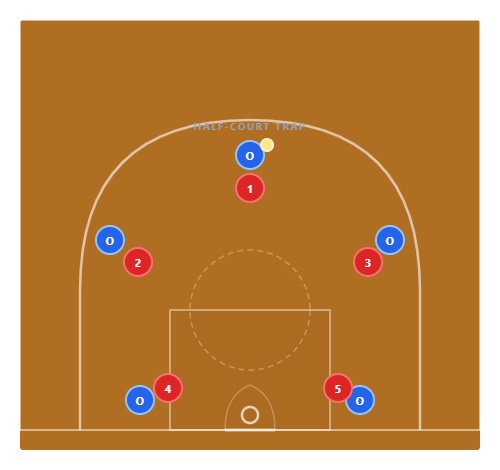
A strategic defense that picks its spots to trap in the half court — usually on the wing, the corner, or after a ball screen. Unlike a full-court press, the half-court trap conserves energy while still generating turnovers and disrupting offensive flow.
Offense
DefenseBall
Disguised Start : The half-court trap begins in a standard man-to-man alignment. The offense thinks it’s a normal possession. Then — on a predetermined trigger (wing pass, ball screen, or coach’s call) — the trap is sprung. The element of surprise is the most important weapon.
Offense
DefenseBall
Wing Trap Sprung :The ball is passed to the wing — that’s the trigger. X2 stays on the ball handler while X1 sprints to double-team from the top. Two defenders collapse on the ball. The ball handler is trapped with the sideline and two defenders. The key: X1 must arrive BEFORE the ball handler can pass or dribble out.
Offense
DefenseBall
3-Man Rotation : While X1 and X2 trap, X3 jumps the passing lane back to the top of the key. X4 drops to cover the nearest baseline player. X5 rotates to the weak side to cover the rim and the skip pass. Three defenders, five possible passing targets — they must anticipate, not react.
Offense
DefenseBall
Recovery :If the trap is broken (a skip pass over the top, a split dribble, or a quick reversal), all five defenders sprint back to their man immediately. No hesitation. The half-court trap is only effective if the recovery is disciplined. A broken trap without recovery = a 4-on-3 fast break for the offense.
1
Pick Your Spot
Trap at specific triggers — wing entry, ball screen, or dribble
2
Sprint & Trap
The second defender attacks on a specific trigger — it's planned, not random
3
Rotate 3
The other 3 defenders rotate to cover passing lanes and the rim
4
Fall Back
If the trap is beaten, recover to man immediately
Who Runs It
Many programs use half-court traps situationally — after timeouts, in crunch time, or as a change of pace. Rick Pitino's Louisville was known for mixing half-court traps into their man defense.
Best Against
Teams with weak ball handlers, poor decision-makers, or point guards who are uncomfortable under pressure. Also effective against teams not accustomed to seeing it.
Weakness
If the ball handler stays calm and finds the skip pass, the defense is in scramble mode. Great passing teams will punish the trap with easy kick-ahead baskets. Can't be used every possession — it's a tool, not a system.