Baseline (BLOB) and sideline (SLOB) inbound plays that every college program runs. Click any play, then step through the action on the court.
01
Stack
BASELINE
BLOB
Quick Hitter
Layup
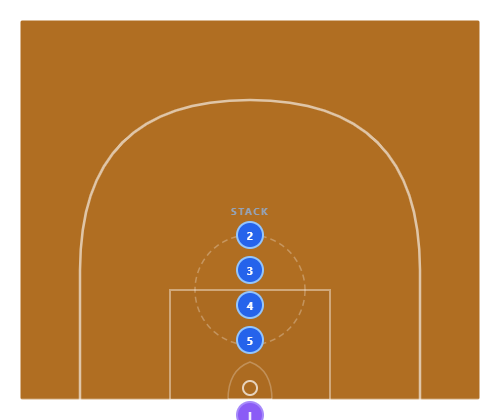
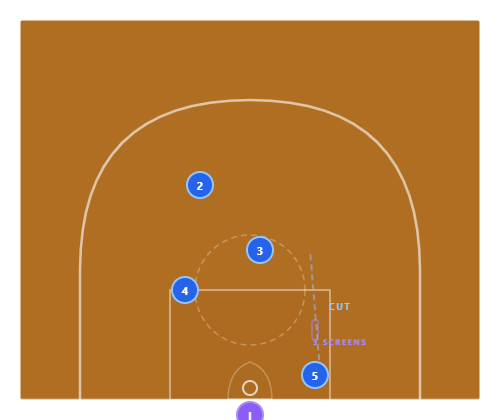
The most common baseline out-of-bounds play in basketball. Four players stack in a vertical line near the lane. On the slap of the ball, they scatter in different directions — at least one player will be open for a catch near the rim.
Inbounder
Offense
Read Order : First look: 5 cutting to the near block — a quick catch for a layup. Second look: 4 on the far block for a lob. Third look: 3 or 2 popping to the wings for a catch-and-shoot. The inbounder has 5 seconds and 4 options — someone is always open if the cuts are sharp.
Inbounder
Offense
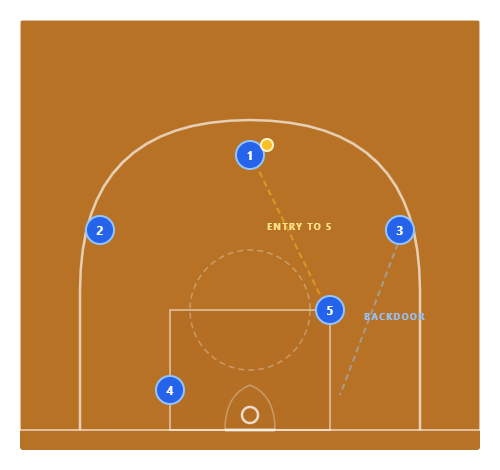
Entry & Backdoor :1 passes to 5 at the high post. 3’s defender turns their head to watch the ball — that’s the cue. 3 immediately cuts backdoor. 5 hits 3 with a bounce pass for a layup. This is the Princeton Offense in its purest form: one pass, one read, one cut.
Inbounder
Offense
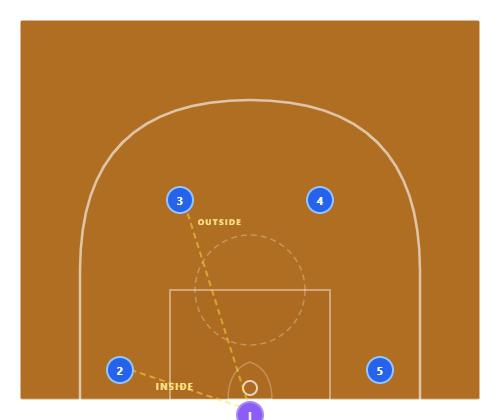
Wing Entry — High-Low : 2 passes to 5 at the elbow. 5 looks inside to 4 on the block (high-low). If 4 is sealed, that’s a layup. If not, 1 cuts through the lane looking for a return pass. The defense is pulled in multiple directions — somebody is open.
Why It Works
The stack creates four simultaneous screens. Defenders can't fight through without losing their man. Even if the defense switches, someone ends up with a size or speed mismatch near the rim.
Counter
If the defense cheats toward the basket, the pop-out to the wings becomes the primary option. The stack is self-adjusting — wherever the defense cheats, the opposite action is open.
02
Box
BASELINE
BLOB
Versatile
Screens
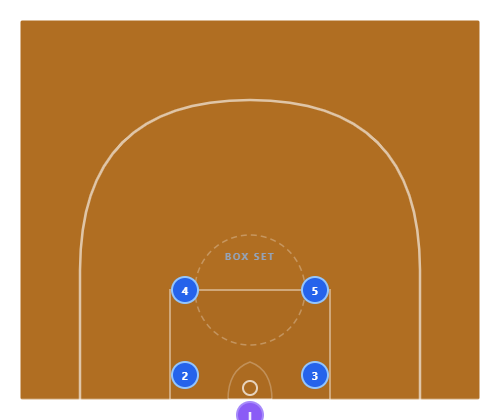
Four players form a box shape — two on the elbows, two on the blocks. The box creates natural screening angles and multiple cutting lanes. The most versatile BLOB alignment because you can run dozens of actions from the same look.
Inbounder
Offense
Box Alignment: 4 and 5 are at the elbows (free-throw line corners). 2 and 3 are on the blocks. This creates a rectangle with the inbounder underneath. Four screeners, four cutters — the possibilities are endless from this single formation.
Inbounder
Offense
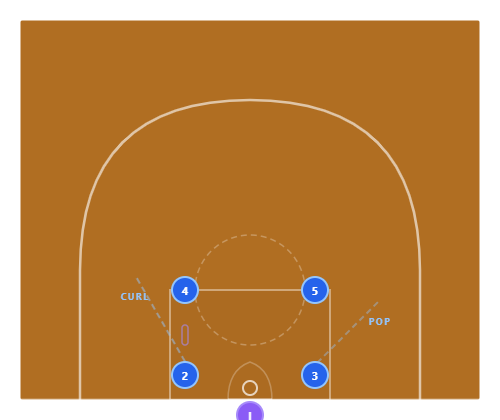
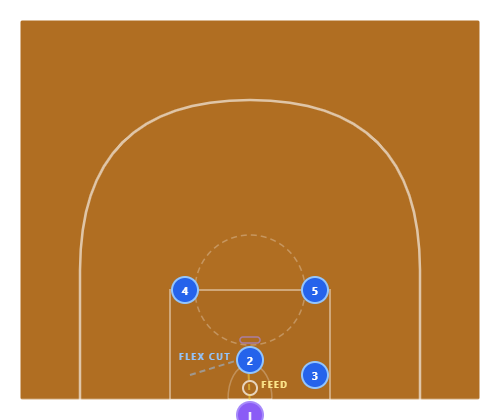
Option A — Cross Screen :4 screens down for 2. 2 curls off the screen to the elbow — open for a mid-range jumper or a catch-and-drive. 3 pops to the opposite wing as a safety outlet. The inbounder reads which action creates the best look.
Inbounder
Offense
Option B — Flex Action : 3 screens across the baseline for 2. 2 uses the flex screen and cuts across the lane for a layup. The inbounder hits 2 on the cut with a bounce pass. This is the highest-percentage action from the box — a layup if the screen is set well.
Why It Works
The box gives you built-in screens at every angle. You can run flex cuts, cross screens, down screens, or pops — all from the same starting formation. The defense can't prepare for every option.
Key Detail
The inbounder must make eye contact with the cutter. Fake one direction with your eyes, then pass the other way. The inbounder's fakes are half the play.
03
Line
BASELINE
BLOB
Misdirection
Quick
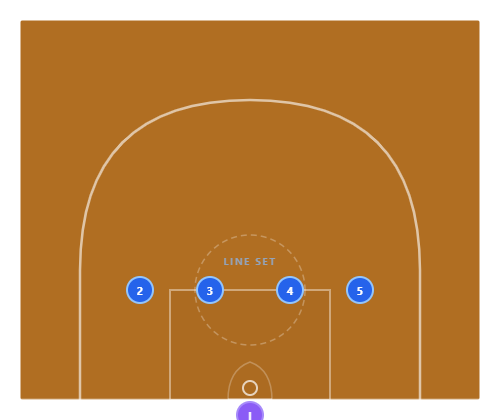
Four players line up horizontally across the free-throw line. On the break, they cut in opposite directions — two to the basket, two to the perimeter. Simple misdirection that creates immediate confusion.
Inbounder
Offense
Line Alignment: All four players stretch across the free-throw line in a horizontal line. Defenders must line up behind them, making it impossible to see both the ball and the cutter. The inbounder chooses which side to attack with a pre-determined call.
Inbounder
Offense
The Split : 2 and 5 cut DOWN to the blocks — looking for the layup. 3 and 4 pop UP to the wings — looking for the catch-and-shoot. The defense is pulled in two directions at once. The inbounder reads who has the advantage.
Inbounder
Offense
The Read : If the defense follows the cutters inside → pass to a wing for an open three. If the defense stays home on the shooters → lob to the block cutter for a layup. The line forces the defense to choose — and punishes whichever choice they make.
Why It Works
Horizontal alignment creates a natural "pick your poison" — every defender is screened by the player next to them as they break in opposite directions.
Key Detail
Best in late-game situations when you need a quick, reliable look. The line is fast-hitting — if the first option is open, the play is over in 1 second.
04
Zipper
BASELINE
BLOB
Continuity
Layup
A “screen the screener” action where the first screen frees a cutter, then the screener immediately gets a screen from another player. Two consecutive actions that force the defense to navigate multiple screens in rapid succession.
Inbounder
Offense
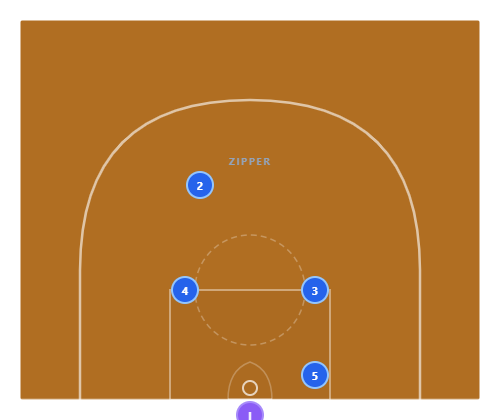
Zipper Setup: 5 is on the ball-side block. 4 and 3 are at the elbows. 2 is at the top of the key. The action will flow from the block upward in a “zipper” pattern — screen, cut, screen, cut.
Inbounder
Offense
First Action : 3 sets a screen for 5 on the block. 5 uses the screen and cuts up to the elbow — if open, the inbounder hits 5 for a mid-range look. This first action draws the defense’s attention and sets up the second action.
Inbounder
Offense
Screen the Screener : After screening for 5, 3 immediately gets a screen from 4. 3 curls off 4’s screen and dives to the basket. The inbounder hits 3 with a bounce pass for a layup. The defense already used energy on the first action — they can’t recover for the second.
Why It Works
The "screen the screener" concept gives the defense two problems in rapid succession. Even if they handle the first screen, the second one catches them off balance.
Key Detail
The screener (3) must set a solid first screen — then immediately sprint to USE the second screen. Lazy screeners make this play worthless.
05
Lob
BASELINE
BLOB
Lob
Buzzer Beater
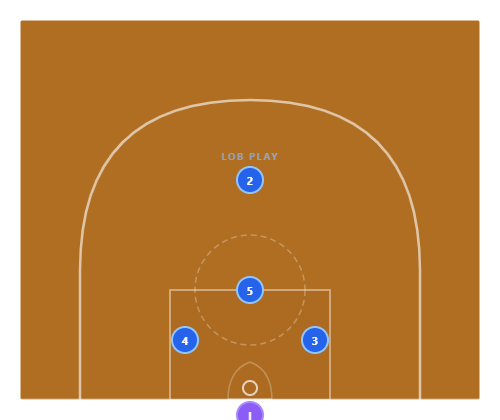
A designed lob play for end-of-game situations when you need a quick two points. A big man seals his defender near the rim while screens clear out the help. The inbounder lobs over the defense for a catch-and-finish.
Inbounder
Offense
Lob Setup: 5 is at the free-throw line. 4 and 3 are on the blocks. 2 is at the top of the key. The play is designed for 5 to seal and receive a lob at the rim, with 4 and 3 screening away the help defenders.
Inbounder
Offense
Clear Out : 4 and 3 pop to the wings, taking their defenders (and potential help defenders) away from the basket. This clears the lane for 5. Meanwhile, 5 turns and seals their defender on their back, creating a passing window for the lob.
Inbounder
Offense
The Lob : 5 dives from the elbow to the rim, sealing their defender behind them. The inbounder throws a lob over the top — 5 catches at the rim for a dunk or layup. If the lob isn’t there, the inbounder hits 2 at the top as the safe outlet. This play scores 80%+ of the time when the seal is strong.
Why It Works
End of half, end of game, or any time you need a guaranteed two points. The lob is unstoppable if 5 has position and the lane is clear.
Key Detail
The inbounder must sell a fake to one wing before throwing the lob. Misdirection gives 5 an extra half-second to get position.
06
Kentucky
BASELINE
BLOB
Corner 3
Famous
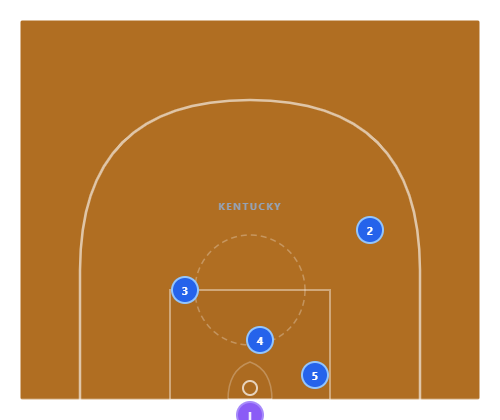
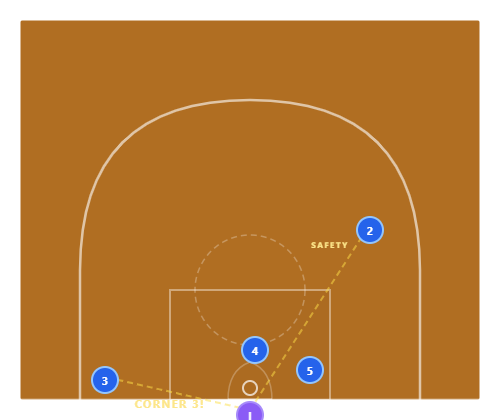
A classic named play used by John Calipari’s Kentucky teams. Features a staggered double screen along the baseline that frees a shooter for an open corner three — one of the highest-percentage shots in basketball.
Inbounder
Offense
Kentucky Setup: 5 is on the ball-side block. 4 is on the ball-side elbow area. 3 is on the opposite elbow. 2 is on the far wing. The play is designed to free 3 for a corner three using a staggered double screen from 5 and 4.
Inbounder
Offense
Baseline Double Screen : 5 and 4 set a staggered double screen across the baseline. 3 runs the baseline, using both screens. The first screen (5) rubs off 3’s defender. The second screen (4) catches any switch or recovery attempt. By the time 3 reaches the corner, they’re wide open.
Inbounder
Offense
Corner Three : 3 catches in the corner — the double screen has given them a clean look. The inbounder hits 3 for the open corner three. If the defense hard-closes on 3, 5 will be open rolling to the rim after setting the screen. 2 is the safety outlet on the far wing.
Why It Works
Two consecutive screens on the baseline are nearly impossible to navigate. The second screen catches any switch attempt. The corner three is the most efficient shot in basketball.
Key Detail
Named after Calipari's Kentucky but run by dozens of programs. The double-screen corner-three concept is universal.
07
Floppy
BASELINE
BLOB
Flexible
3PT
Two shooters start at the blocks and read the defense to choose which screen to use. They can “flop” to either side — curling tight for a layup or popping wide for a three. The defense can’t jump the route because the cutter decides at the last second.
Inbounder
Offense
Floppy Setup: 2 and 3 start on the blocks. 4 and 5 are at the elbows. Each shooter (2 and 3) will read their defender and choose which screen to use — curl around the elbow screen (tight) or fade to the corner off the block screen (wide).
Inbounder
Offense
The Read : 2 reads their defender: if the defender goes OVER the elbow screen (staying high), 2 curls UNDER and cuts to the rim for a layup. If the defender goes UNDER (staying low), 2 pops around the elbow screen to the wing for an open jumper. The cutter decides — not the play call.
Inbounder
Offense
The Delivery : Both shooters make their reads simultaneously. The inbounder picks the best option — in this case, 2 has curled to the wing for an open three. 3 has faded to the far wing as the secondary option. The beauty of Floppy: the offense adjusts to the defense in real time.
Why It Works
The defense can't jump the route because the cutter chooses their path based on coverage. Go over → curl. Go under → pop. It's an automatic counter every time.
Who Runs It
Virtually every NBA and college team runs Floppy. It's one of the most universal plays in basketball because of its simplicity and adaptability.
08
Hammer
BASELINE
BLOB
Skip Pass
Corner 3
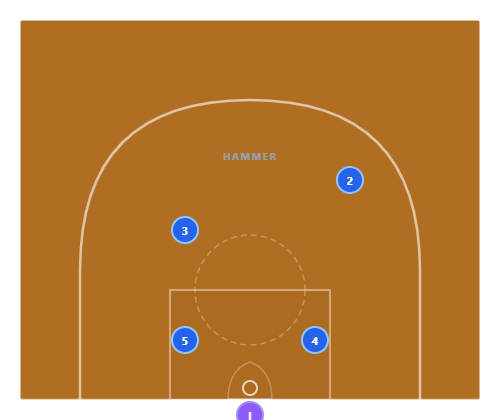
A misdirection play that draws the defense to the ball side, then skips the ball to a shooter in the weak-side corner. The “hammer” screen frees the corner shooter — and the defense is already leaning the wrong way.
Inbounder
Offense
Hammer Setup: 5 and 4 on the blocks. 3 at the ball-side wing. 2 at the top of the key (far side). The play starts with action toward the ball side to draw the defense, then reverses to the weak-side corner.
Inbounder
Offense
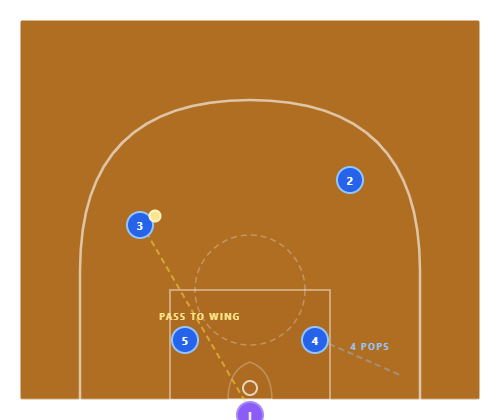
Draw the Defense : The inbounder passes to 3 on the ball-side wing. The defense shifts toward the ball — help defenders cheat toward 3. Meanwhile, 4 quietly relocates to the weak-side corner. The entire defense is now watching the ball on the left side.
Inbounder
Offense
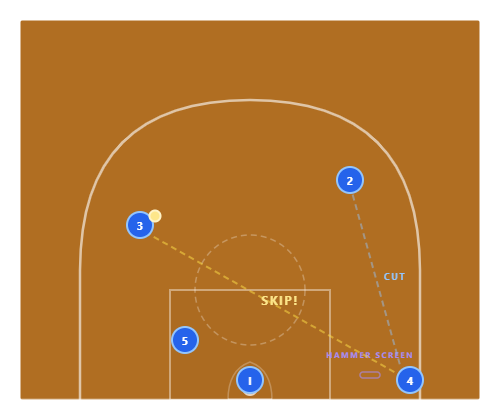
The Hammer : 5 sets a “hammer screen” for 4 near the weak-side baseline. 4 catches the skip pass from 3 in the corner — WIDE open. The defense shifted left, the screen cleared the remaining help, and the skip pass traveled faster than the defense could recover. Open corner three.
Why It Works
Misdirection is the key. The initial ball-side pass makes the defense commit, and the skip pass exploits that commitment. The hammer screen removes the last potential help defender.
Key Detail
The "hammer" concept is one of the most efficient plays in modern basketball. The corner three after a hammer screen is one of the highest-PPP shots available.
09
UCLA Cut
BASELINE
BLOB
Backdoor
Layup
Adapted from the classic UCLA offense. The play features a UCLA cut — a pass to the wing followed by a cut off a high-post screen directly to the basket. Creates backdoor layups against aggressive, overplaying defenses.
Inbounder
Offense
UCLA Cut Setup: 5 is at the free-throw line. 4 is on the ball-side block. 3 and 2 are on the wings. The play is designed to get a layup by cutting off 5’s screen at the elbow — the classic UCLA cut brought into an out-of-bounds play.
Inbounder
Offense
Wing Entry : The inbounder passes to 3 on the wing. Standard — nothing fancy. But as 3 catches, the action is about to start. The defense relaxes because it looks like a standard inbound-to-wing entry. That’s when the UCLA cut strikes.
Inbounder
Offense
The UCLA Cut : The inbounder, after passing, cuts directly toward 5’s screen at the free-throw line. They use 5’s body as a screen and cut backdoor to the rim. 3 hits the cutter with a bounce pass for a layup. The inbounder scoring is unexpected — defenders often forget to guard the passer after the inbound.
Why It Works
After inbounding, most defenses forget about the passer. The UCLA cut exploits this by turning the inbounder into the primary scorer. It's the ultimate "hide in plain sight" play.
Key Detail
5's screen at the elbow must be set at the exact right time — not too early (gives the defense time to adjust) and not too late (the inbounder runs past it).
10
Iverson
BASELINE
BLOB
Iso
Star Play
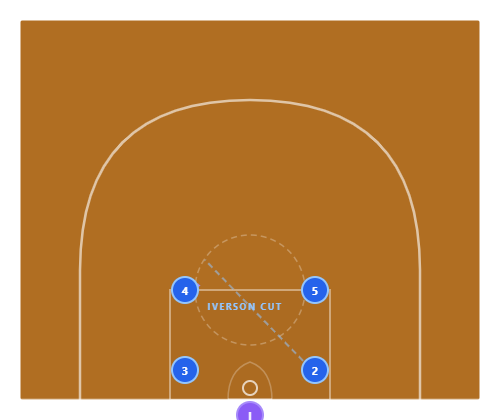
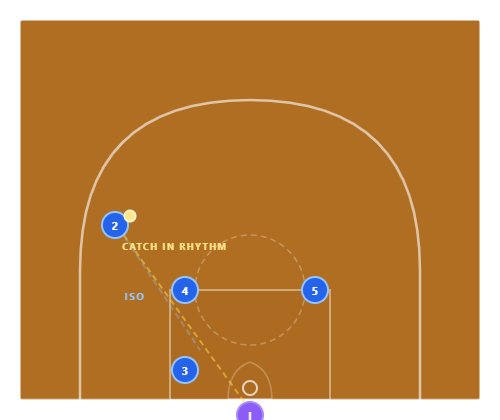
Named after Allen Iverson. A play designed to get your best scorer the ball in space on the wing with a running start. Two staggered screens across the free-throw line free the scorer for a catch in rhythm — with room to operate.
Inbounder
Offense
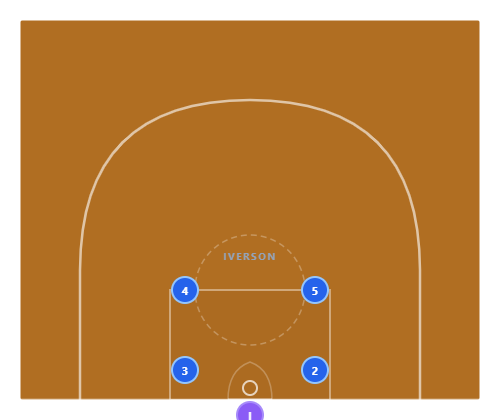
Iverson Setup: Box formation — 4 and 5 at the elbows, 3 and 2 on the blocks. The star player (2) is on the weak-side block. The play is designed to free 2 with a pair of staggered screens across the free-throw line for a wing catch in rhythm.
Inbounder
Offense
The Iverson Cut : 2 runs across the free-throw line, using 5 and 4 as staggered screens — first off 5, then off 4. Both bigs must set firm, wide screens. 2 reads the defense and can pop to either wing — typically the ball-side wing for the inbound pass.
Inbounder
Offense
Catch & Go : 2 catches on the wing with momentum and space. From here, it’s isolation — 2 can drive, shoot, or create. The staggered screens gave 2 a clean catch with their defender trailing. Floor is spaced, 3 and the bigs create driving lanes. Let the star player cook.
Why It Works
Two staggered screens are extremely difficult to navigate. The scorer gets the ball moving, in rhythm, with space — the best possible situation for an elite player.
Key Detail
When you need your best player to have the ball with a chance to create. Late-game, late-clock, or any time you want to put the ball in your scorer's hands.
11
Delay
BASELINE
SLOB
Late Game
Back Screen
A sideline play designed for late-game situations. The ball is entered safely, then a back screen creates a layup opportunity. If the layup isn’t there, the offense flows into a ball-screen set to run the clock down.
Inbounder
Offense
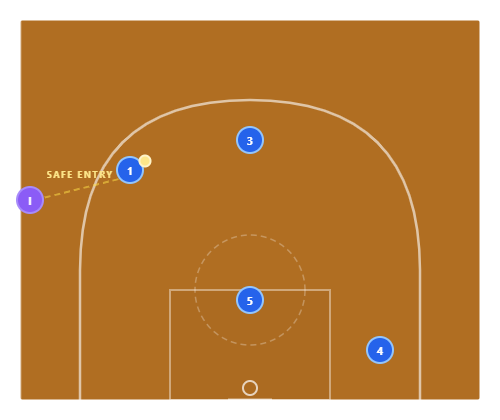
Delay Setup: Sideline inbound near the offensive end. 1 is near the ball as the primary outlet. 3 is at the top of the key. 5 is at the elbow. 4 is on the weak-side block. The play is designed for a safe entry, then a quick-strike back screen.
Inbounder
Offense
Safe Entry :The inbounder passes to 1 — the safest, highest-IQ ball handler on the team. 1 catches facing the court. No pressure, no drama. Now the play begins..
Inbounder
Offense
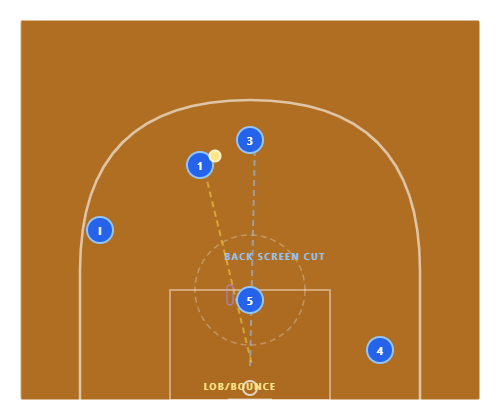
Back Screen Lob : 5 sets a back screen for 3. 3 cuts backdoor off 5’s screen and dives to the rim. 1 hits 3 with a lob or bounce pass for a layup. If 3 isn’t open, 5 pops to the top after screening and 1 uses 5 for a ball screen. The play flows seamlessly from quick-strike to half-court set.
Why It Works
The back screen is devastating in a sideline inbound because the defense is already displaced by the dead-ball reset. The cutter gets a running start while the defender is stationary.
Key Detail
Perfect for up-3 or up-5 situations — you either get an easy layup to extend the lead or burn 15+ seconds of clock before flowing into your half-court offense.
12
Punch
SIDELINE
SLOB
PNR
Quick Hitter
A sideline inbound that flows immediately into a ball screen (pick and roll). The entry is quick, and the ball handler attacks off the screen before the defense can set up. Transition offense from a dead ball.
Inbounder
Offense
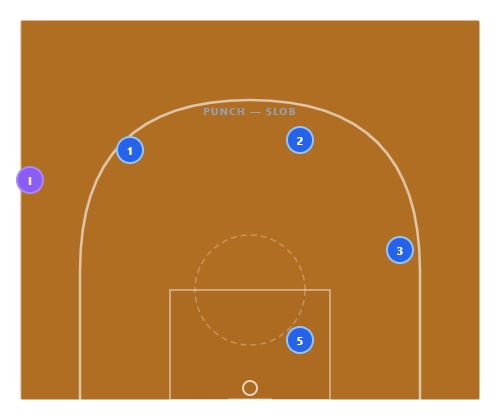
Punch Setup: Sideline inbound at the wing area. 1 is the primary outlet near the ball. 2 and 3 are spaced on the perimeter. 5 is at the ball-side elbow area, ready to set a ball screen immediately after the inbound entry.
Inbounder
Offense
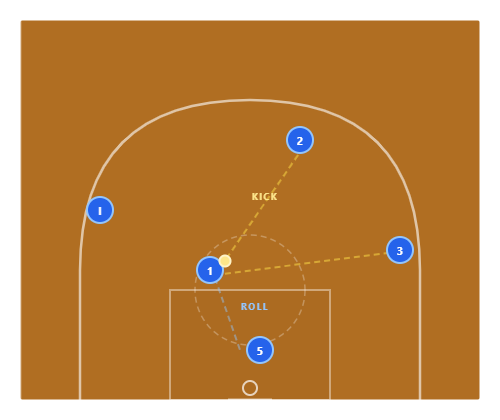
Instant PNR :1 catches the inbound and immediately uses 5’s ball screen. No hesitation — the screen is already set as 1 catches. 1 drives off the screen toward the paint before the defense can organize. This is the “punch” — an immediate, aggressive attack from a dead ball.
Inbounder
Offense
Standard PNR Reads : 1 reads the defense off the screen — all normal PNR rules apply. Pocket pass to 5 rolling. Kick to 2 at the top for a three. Drive and finish. Skip to 3 on the far wing. The advantage: the defense hasn’t had time to set up their PNR coverage because it happened so fast off the inbound.
Why It Works
The defense expects a structured inbound play — instead, you attack them with a ball screen before they're set. The transition from dead ball to live PNR is jarring for defenders.
Who Runs It
Almost every program has a "quick PNR" sideline play. Houston, UConn, and Kansas all use versions of this concept.
13
Slice
SIDELINE
SLOB
Backdoor
Misdirection
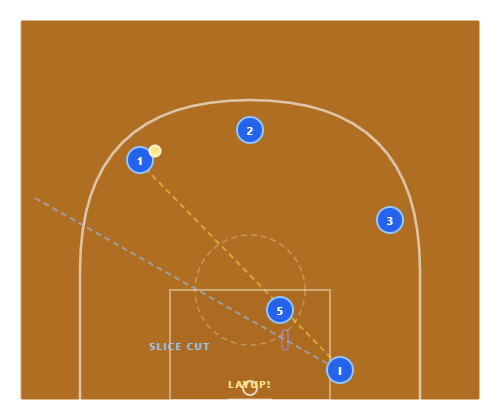
A sideline play where the entry pass goes to the wing, and the inbounder “slices” across the baseline using a screen for a layup. Like the UCLA Cut BLOB, the inbounder becomes the scorer — catching the defense off guard.
Inbounder
Offense
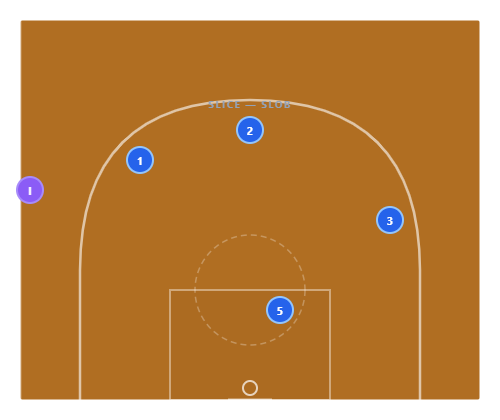
Slice Setup: Sideline inbound at the wing area. 1 and 2 are spaced on the perimeter. 3 is on the far wing. 5 is at the ball-side elbow. After the entry pass, the inbounder will “slice” along the baseline for a layup.
Inbounder
Offense
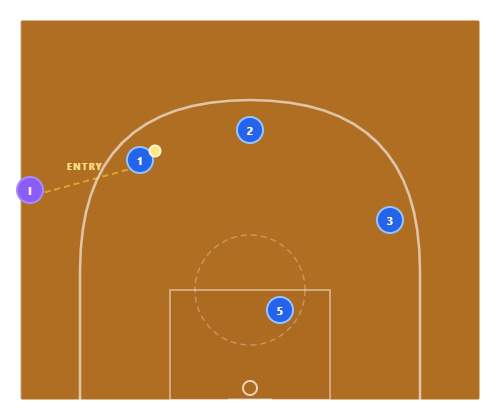
Safe Entry :The inbounder passes to 1 on the near wing. Simple, clean entry — nothing that alerts the defense. But the real play is about to happen. After passing, the inbounder doesn’t just stand there…
Inbounder
Offense
The Slice : The inbounder cuts baseline, using 5’s screen at the elbow. They “slice” across the lane and pop out on the far block. 1 hits the slicer with a bounce pass for a layup. The defense loses track of the passer — and the screen from 5 catches any recovery attempt.
Why It Works
Defenders consistently ball-watch after the inbound pass, losing the passer. The slice exploits this universal tendency. 5's screen ensures the slicer arrives at the rim alone.
Versatility
If the slice isn't open, 5 pops after screening and 1 can enter the ball to 5 at the elbow for a mid-range or high-low action. It flows naturally.
14
Pistol
SIDELINE
SLOB
Dribble Handoff
Guard Play
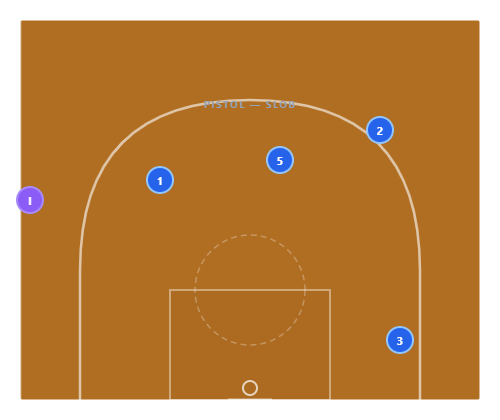
A guard-oriented sideline play featuring a dribble handoff (DHO) immediately after the inbound entry. The ball handler receives the handoff with a full head of steam, attacking a defense that hasn’t had time to organize.
Inbounder
Offense
Pistol Setup: 1 is the primary outlet. 5 is at the top of the key. 2 is on the far wing. 3 is in the far corner. The play is designed to get a DHO from 5 to 1 immediately after the entry — attacking the defense before they can set their half-court defense.
Inbounder
Offense
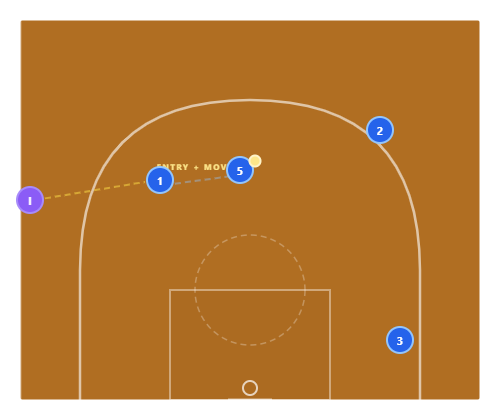
Entry to 5 :The inbounder passes to 1, who immediately passes to 5 popping to the top. Or the inbounder can go directly to 5. 1 then cuts toward 5 for the dribble handoff. The timing is everything — 1 must arrive at 5 just as 5 catches.
Inbounder
Offense
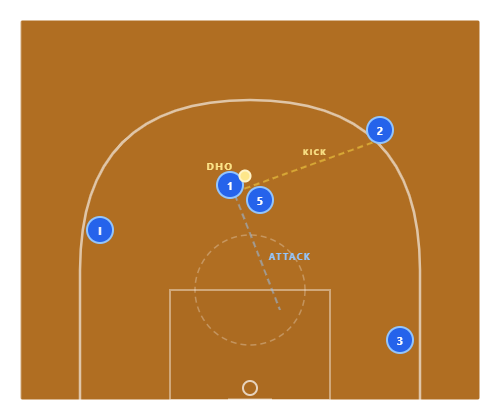
DHO Attack : 5 hands off to 1 on the move. 1 attacks off the handoff with momentum — driving toward the paint. 5 rolls to the rim after the handoff. If the defense helps on the drive, 1 kicks to 2 on the wing or 3 in the corner. The DHO creates a 2-on-1 advantage out of a dead ball.
Why It Works
The dribble handoff creates instant offense from a dead ball. The ball handler has momentum, the defense is flat-footed, and the spacing creates multiple passing options off the drive.
Guard Play
Best when 1 is a dynamic guard who can attack off the handoff. The DHO gives them a running start with a screener rolling — a guard's dream scenario.
15
Horns SLOB
SIDELINE
SLOB
Horns
Versatile
A sideline play that enters the ball into a Horns alignment — two bigs at the elbows. From there, multiple actions are available: ball screen, DHO, iso, or high-low. The most versatile SLOB play because it flows into your half-court offense seamlessly.
Inbounder
Offense
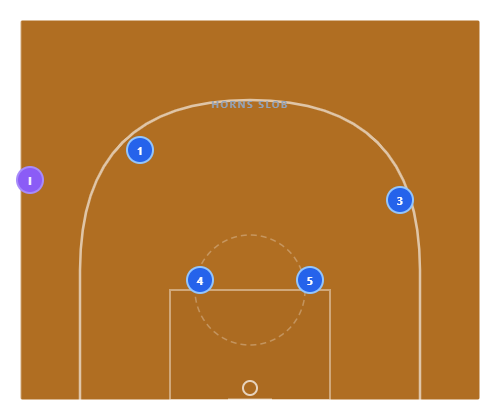
Horns SLOB Setup: 1 is the primary outlet. 4 and 5 are at the elbows in the Horns alignment. 3 is on the far wing. Once the ball is entered and reaches the top of the key, the offense is already in Horns — with all the options that come with it.
Inbounder
Offense
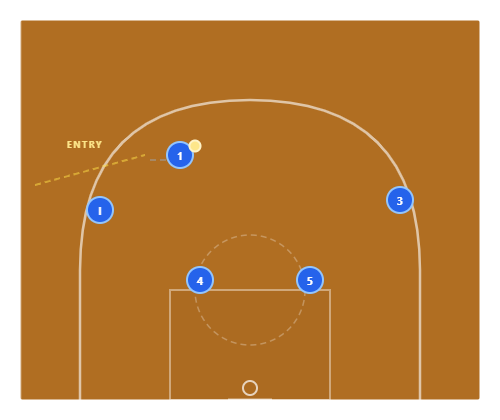
Entry & Set :The inbounder passes to 1. 1 dribbles to the middle of the floor. Now the offense is in a Horns set — 4 and 5 at the elbows, 3 on the wing, and the inbounder filling the far wing. The coach can call any Horns action from here.
Inbounder
Offense
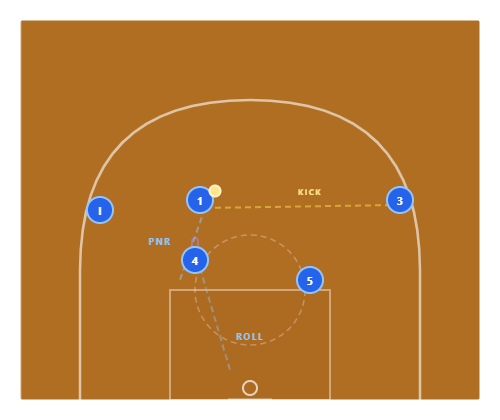
Horns PNR : 4 sets a ball screen for 1 at the elbow. 1 drives off the screen. 4 rolls to the rim. 5 stays spaced at the opposite elbow. 3 is on the wing for the kick-out. Standard Horns PNR — but delivered seamlessly from a dead-ball inbound situation. The defense never gets a chance to set up their PNR coverage.
Why It Works
The Horns SLOB transitions seamlessly from a dead ball into your primary half-court offense. The defense can't differentiate between your inbound play and your regular offense — which means they can't prepare for a specific look.
Versatility
From Horns, you can run PNR, DHO, iso, high-low, or any other action. This single SLOB play gives you access to your entire offensive playbook out of a sideline inbound.
01
Stack
BASELINE
BLOB
Quick Hitter
Layup
The most common baseline out-of-bounds play in basketball. Four players stack in a vertical line near the lane. On the slap of the ball, they scatter in different directions — at least one player will be open for a catch near the rim.
Inbounder
Offense
Read Order : First look: 5 cutting to the near block — a quick catch for a layup. Second look: 4 on the far block for a lob. Third look: 3 or 2 popping to the wings for a catch-and-shoot. The inbounder has 5 seconds and 4 options — someone is always open if the cuts are sharp.
Inbounder
Offense
Entry & Backdoor :1 passes to 5 at the high post. 3’s defender turns their head to watch the ball — that’s the cue. 3 immediately cuts backdoor. 5 hits 3 with a bounce pass for a layup. This is the Princeton Offense in its purest form: one pass, one read, one cut.
Inbounder
Offense
Wing Entry — High-Low : 2 passes to 5 at the elbow. 5 looks inside to 4 on the block (high-low). If 4 is sealed, that’s a layup. If not, 1 cuts through the lane looking for a return pass. The defense is pulled in multiple directions — somebody is open.
Why It Works
The stack creates four simultaneous screens. Defenders can't fight through without losing their man. Even if the defense switches, someone ends up with a size or speed mismatch near the rim.
Counter
If the defense cheats toward the basket, the pop-out to the wings becomes the primary option. The stack is self-adjusting — wherever the defense cheats, the opposite action is open.
02
Box
BASELINE
BLOB
Versatile
Screens
Four players form a box shape — two on the elbows, two on the blocks. The box creates natural screening angles and multiple cutting lanes. The most versatile BLOB alignment because you can run dozens of actions from the same look.
Inbounder
Offense
Box Alignment: 4 and 5 are at the elbows (free-throw line corners). 2 and 3 are on the blocks. This creates a rectangle with the inbounder underneath. Four screeners, four cutters — the possibilities are endless from this single formation.
Inbounder
Offense
Option A — Cross Screen :4 screens down for 2. 2 curls off the screen to the elbow — open for a mid-range jumper or a catch-and-drive. 3 pops to the opposite wing as a safety outlet. The inbounder reads which action creates the best look.
Inbounder
Offense
Option B — Flex Action : 3 screens across the baseline for 2. 2 uses the flex screen and cuts across the lane for a layup. The inbounder hits 2 on the cut with a bounce pass. This is the highest-percentage action from the box — a layup if the screen is set well.
Why It Works
The box gives you built-in screens at every angle. You can run flex cuts, cross screens, down screens, or pops — all from the same starting formation. The defense can't prepare for every option.
Key Detail
The inbounder must make eye contact with the cutter. Fake one direction with your eyes, then pass the other way. The inbounder's fakes are half the play.
03
Line
BASELINE
BLOB
Misdirection
Quick
Four players line up horizontally across the free-throw line. On the break, they cut in opposite directions — two to the basket, two to the perimeter. Simple misdirection that creates immediate confusion.
Inbounder
Offense
Line Alignment: All four players stretch across the free-throw line in a horizontal line. Defenders must line up behind them, making it impossible to see both the ball and the cutter. The inbounder chooses which side to attack with a pre-determined call.
Inbounder
Offense
The Split : 2 and 5 cut DOWN to the blocks — looking for the layup. 3 and 4 pop UP to the wings — looking for the catch-and-shoot. The defense is pulled in two directions at once. The inbounder reads who has the advantage.
Inbounder
Offense
The Read : If the defense follows the cutters inside → pass to a wing for an open three. If the defense stays home on the shooters → lob to the block cutter for a layup. The line forces the defense to choose — and punishes whichever choice they make.
Why It Works
Horizontal alignment creates a natural "pick your poison" — every defender is screened by the player next to them as they break in opposite directions.
Key Detail
Best in late-game situations when you need a quick, reliable look. The line is fast-hitting — if the first option is open, the play is over in 1 second.
04
Zipper
BASELINE
BLOB
Continuity
Layup
A “screen the screener” action where the first screen frees a cutter, then the screener immediately gets a screen from another player. Two consecutive actions that force the defense to navigate multiple screens in rapid succession.
Inbounder
Offense
Zipper Setup: 5 is on the ball-side block. 4 and 3 are at the elbows. 2 is at the top of the key. The action will flow from the block upward in a “zipper” pattern — screen, cut, screen, cut.
Inbounder
Offense
First Action : 3 sets a screen for 5 on the block. 5 uses the screen and cuts up to the elbow — if open, the inbounder hits 5 for a mid-range look. This first action draws the defense’s attention and sets up the second action.
Inbounder
Offense
Screen the Screener : After screening for 5, 3 immediately gets a screen from 4. 3 curls off 4’s screen and dives to the basket. The inbounder hits 3 with a bounce pass for a layup. The defense already used energy on the first action — they can’t recover for the second.
Why It Works
The "screen the screener" concept gives the defense two problems in rapid succession. Even if they handle the first screen, the second one catches them off balance.
Key Detail
The screener (3) must set a solid first screen — then immediately sprint to USE the second screen. Lazy screeners make this play worthless.
05
Lob
BASELINE
BLOB
Lob
Buzzer Beater
A designed lob play for end-of-game situations when you need a quick two points. A big man seals his defender near the rim while screens clear out the help. The inbounder lobs over the defense for a catch-and-finish.
Inbounder
Offense
Lob Setup: 5 is at the free-throw line. 4 and 3 are on the blocks. 2 is at the top of the key. The play is designed for 5 to seal and receive a lob at the rim, with 4 and 3 screening away the help defenders.
Inbounder
Offense
Clear Out : 4 and 3 pop to the wings, taking their defenders (and potential help defenders) away from the basket. This clears the lane for 5. Meanwhile, 5 turns and seals their defender on their back, creating a passing window for the lob.
Inbounder
Offense
The Lob : 5 dives from the elbow to the rim, sealing their defender behind them. The inbounder throws a lob over the top — 5 catches at the rim for a dunk or layup. If the lob isn’t there, the inbounder hits 2 at the top as the safe outlet. This play scores 80%+ of the time when the seal is strong.
Why It Works
End of half, end of game, or any time you need a guaranteed two points. The lob is unstoppable if 5 has position and the lane is clear.
Key Detail
The inbounder must sell a fake to one wing before throwing the lob. Misdirection gives 5 an extra half-second to get position.
06
Kentucky
BASELINE
BLOB
Corner 3
Famous
A classic named play used by John Calipari’s Kentucky teams. Features a staggered double screen along the baseline that frees a shooter for an open corner three — one of the highest-percentage shots in basketball.
Inbounder
Offense
Kentucky Setup: 5 is on the ball-side block. 4 is on the ball-side elbow area. 3 is on the opposite elbow. 2 is on the far wing. The play is designed to free 3 for a corner three using a staggered double screen from 5 and 4.
Inbounder
Offense
Baseline Double Screen : 5 and 4 set a staggered double screen across the baseline. 3 runs the baseline, using both screens. The first screen (5) rubs off 3’s defender. The second screen (4) catches any switch or recovery attempt. By the time 3 reaches the corner, they’re wide open.
Inbounder
Offense
Corner Three : 3 catches in the corner — the double screen has given them a clean look. The inbounder hits 3 for the open corner three. If the defense hard-closes on 3, 5 will be open rolling to the rim after setting the screen. 2 is the safety outlet on the far wing.
Why It Works
Two consecutive screens on the baseline are nearly impossible to navigate. The second screen catches any switch attempt. The corner three is the most efficient shot in basketball.
Key Detail
Named after Calipari's Kentucky but run by dozens of programs. The double-screen corner-three concept is universal.
07
Floppy
BASELINE
BLOB
Flexible
3PT
Two shooters start at the blocks and read the defense to choose which screen to use. They can “flop” to either side — curling tight for a layup or popping wide for a three. The defense can’t jump the route because the cutter decides at the last second.
Inbounder
Offense
Floppy Setup: 2 and 3 start on the blocks. 4 and 5 are at the elbows. Each shooter (2 and 3) will read their defender and choose which screen to use — curl around the elbow screen (tight) or fade to the corner off the block screen (wide).
Inbounder
Offense
The Read : 2 reads their defender: if the defender goes OVER the elbow screen (staying high), 2 curls UNDER and cuts to the rim for a layup. If the defender goes UNDER (staying low), 2 pops around the elbow screen to the wing for an open jumper. The cutter decides — not the play call.
Inbounder
Offense
The Delivery : Both shooters make their reads simultaneously. The inbounder picks the best option — in this case, 2 has curled to the wing for an open three. 3 has faded to the far wing as the secondary option. The beauty of Floppy: the offense adjusts to the defense in real time.
Why It Works
The defense can't jump the route because the cutter chooses their path based on coverage. Go over → curl. Go under → pop. It's an automatic counter every time.
Who Runs It
Virtually every NBA and college team runs Floppy. It's one of the most universal plays in basketball because of its simplicity and adaptability.
08
Hammer
BASELINE
BLOB
Skip Pass
Corner 3
A misdirection play that draws the defense to the ball side, then skips the ball to a shooter in the weak-side corner. The “hammer” screen frees the corner shooter — and the defense is already leaning the wrong way.
Inbounder
Offense
Hammer Setup: 5 and 4 on the blocks. 3 at the ball-side wing. 2 at the top of the key (far side). The play starts with action toward the ball side to draw the defense, then reverses to the weak-side corner.
Inbounder
Offense
Draw the Defense : The inbounder passes to 3 on the ball-side wing. The defense shifts toward the ball — help defenders cheat toward 3. Meanwhile, 4 quietly relocates to the weak-side corner. The entire defense is now watching the ball on the left side.
Inbounder
Offense
The Hammer : 5 sets a “hammer screen” for 4 near the weak-side baseline. 4 catches the skip pass from 3 in the corner — WIDE open. The defense shifted left, the screen cleared the remaining help, and the skip pass traveled faster than the defense could recover. Open corner three.
Why It Works
Misdirection is the key. The initial ball-side pass makes the defense commit, and the skip pass exploits that commitment. The hammer screen removes the last potential help defender.
Key Detail
The "hammer" concept is one of the most efficient plays in modern basketball. The corner three after a hammer screen is one of the highest-PPP shots available.
09
UCLA Cut
BASELINE
BLOB
Backdoor
Layup
Adapted from the classic UCLA offense. The play features a UCLA cut — a pass to the wing followed by a cut off a high-post screen directly to the basket. Creates backdoor layups against aggressive, overplaying defenses.
Inbounder
Offense
UCLA Cut Setup: 5 is at the free-throw line. 4 is on the ball-side block. 3 and 2 are on the wings. The play is designed to get a layup by cutting off 5’s screen at the elbow — the classic UCLA cut brought into an out-of-bounds play.
Inbounder
Offense
Wing Entry : The inbounder passes to 3 on the wing. Standard — nothing fancy. But as 3 catches, the action is about to start. The defense relaxes because it looks like a standard inbound-to-wing entry. That’s when the UCLA cut strikes.
Inbounder
Offense
The UCLA Cut : The inbounder, after passing, cuts directly toward 5’s screen at the free-throw line. They use 5’s body as a screen and cut backdoor to the rim. 3 hits the cutter with a bounce pass for a layup. The inbounder scoring is unexpected — defenders often forget to guard the passer after the inbound.
Why It Works
After inbounding, most defenses forget about the passer. The UCLA cut exploits this by turning the inbounder into the primary scorer. It's the ultimate "hide in plain sight" play.
Key Detail
5's screen at the elbow must be set at the exact right time — not too early (gives the defense time to adjust) and not too late (the inbounder runs past it).
10
Iverson
BASELINE
BLOB
Iso
Star Play
Named after Allen Iverson. A play designed to get your best scorer the ball in space on the wing with a running start. Two staggered screens across the free-throw line free the scorer for a catch in rhythm — with room to operate.
Inbounder
Offense
Iverson Setup: Box formation — 4 and 5 at the elbows, 3 and 2 on the blocks. The star player (2) is on the weak-side block. The play is designed to free 2 with a pair of staggered screens across the free-throw line for a wing catch in rhythm.
Inbounder
Offense
The Iverson Cut : 2 runs across the free-throw line, using 5 and 4 as staggered screens — first off 5, then off 4. Both bigs must set firm, wide screens. 2 reads the defense and can pop to either wing — typically the ball-side wing for the inbound pass.
Inbounder
Offense
Catch & Go : 2 catches on the wing with momentum and space. From here, it’s isolation — 2 can drive, shoot, or create. The staggered screens gave 2 a clean catch with their defender trailing. Floor is spaced, 3 and the bigs create driving lanes. Let the star player cook.
Why It Works
Two staggered screens are extremely difficult to navigate. The scorer gets the ball moving, in rhythm, with space — the best possible situation for an elite player.
Key Detail
When you need your best player to have the ball with a chance to create. Late-game, late-clock, or any time you want to put the ball in your scorer's hands.
11
Delay
BASELINE
SLOB
Late Game
Back Screen
A sideline play designed for late-game situations. The ball is entered safely, then a back screen creates a layup opportunity. If the layup isn’t there, the offense flows into a ball-screen set to run the clock down.
Inbounder
Offense
Delay Setup: Sideline inbound near the offensive end. 1 is near the ball as the primary outlet. 3 is at the top of the key. 5 is at the elbow. 4 is on the weak-side block. The play is designed for a safe entry, then a quick-strike back screen.
Inbounder
Offense
Safe Entry :The inbounder passes to 1 — the safest, highest-IQ ball handler on the team. 1 catches facing the court. No pressure, no drama. Now the play begins..
Inbounder
Offense
Back Screen Lob : 5 sets a back screen for 3. 3 cuts backdoor off 5’s screen and dives to the rim. 1 hits 3 with a lob or bounce pass for a layup. If 3 isn’t open, 5 pops to the top after screening and 1 uses 5 for a ball screen. The play flows seamlessly from quick-strike to half-court set.
Why It Works
The back screen is devastating in a sideline inbound because the defense is already displaced by the dead-ball reset. The cutter gets a running start while the defender is stationary.
Key Detail
Perfect for up-3 or up-5 situations — you either get an easy layup to extend the lead or burn 15+ seconds of clock before flowing into your half-court offense.
12
Punch
SIDELINE
SLOB
PNR
Quick Hitter
A sideline inbound that flows immediately into a ball screen (pick and roll). The entry is quick, and the ball handler attacks off the screen before the defense can set up. Transition offense from a dead ball.
Inbounder
Offense
Punch Setup: Sideline inbound at the wing area. 1 is the primary outlet near the ball. 2 and 3 are spaced on the perimeter. 5 is at the ball-side elbow area, ready to set a ball screen immediately after the inbound entry.
Inbounder
Offense
Instant PNR :1 catches the inbound and immediately uses 5’s ball screen. No hesitation — the screen is already set as 1 catches. 1 drives off the screen toward the paint before the defense can organize. This is the “punch” — an immediate, aggressive attack from a dead ball.
Inbounder
Offense
Standard PNR Reads : 1 reads the defense off the screen — all normal PNR rules apply. Pocket pass to 5 rolling. Kick to 2 at the top for a three. Drive and finish. Skip to 3 on the far wing. The advantage: the defense hasn’t had time to set up their PNR coverage because it happened so fast off the inbound.
Why It Works
The defense expects a structured inbound play — instead, you attack them with a ball screen before they're set. The transition from dead ball to live PNR is jarring for defenders.
Who Runs It
Almost every program has a "quick PNR" sideline play. Houston, UConn, and Kansas all use versions of this concept.
13
Slice
SIDELINE
SLOB
Backdoor
Misdirection
A sideline play where the entry pass goes to the wing, and the inbounder “slices” across the baseline using a screen for a layup. Like the UCLA Cut BLOB, the inbounder becomes the scorer — catching the defense off guard.
Inbounder
Offense
Slice Setup: Sideline inbound at the wing area. 1 and 2 are spaced on the perimeter. 3 is on the far wing. 5 is at the ball-side elbow. After the entry pass, the inbounder will “slice” along the baseline for a layup.
Inbounder
Offense
Safe Entry :The inbounder passes to 1 on the near wing. Simple, clean entry — nothing that alerts the defense. But the real play is about to happen. After passing, the inbounder doesn’t just stand there…
Inbounder
Offense
The Slice : The inbounder cuts baseline, using 5’s screen at the elbow. They “slice” across the lane and pop out on the far block. 1 hits the slicer with a bounce pass for a layup. The defense loses track of the passer — and the screen from 5 catches any recovery attempt.
Why It Works
Defenders consistently ball-watch after the inbound pass, losing the passer. The slice exploits this universal tendency. 5's screen ensures the slicer arrives at the rim alone.
Versatility
If the slice isn't open, 5 pops after screening and 1 can enter the ball to 5 at the elbow for a mid-range or high-low action. It flows naturally.
14
Pistol
SIDELINE
SLOB
Dribble Handoff
Guard Play
A guard-oriented sideline play featuring a dribble handoff (DHO) immediately after the inbound entry. The ball handler receives the handoff with a full head of steam, attacking a defense that hasn’t had time to organize.
Inbounder
Offense
Pistol Setup: 1 is the primary outlet. 5 is at the top of the key. 2 is on the far wing. 3 is in the far corner. The play is designed to get a DHO from 5 to 1 immediately after the entry — attacking the defense before they can set their half-court defense.
Inbounder
Offense
Entry to 5 :The inbounder passes to 1, who immediately passes to 5 popping to the top. Or the inbounder can go directly to 5. 1 then cuts toward 5 for the dribble handoff. The timing is everything — 1 must arrive at 5 just as 5 catches.
Inbounder
Offense
DHO Attack : 5 hands off to 1 on the move. 1 attacks off the handoff with momentum — driving toward the paint. 5 rolls to the rim after the handoff. If the defense helps on the drive, 1 kicks to 2 on the wing or 3 in the corner. The DHO creates a 2-on-1 advantage out of a dead ball.
Why It Works
The dribble handoff creates instant offense from a dead ball. The ball handler has momentum, the defense is flat-footed, and the spacing creates multiple passing options off the drive.
Guard Play
Best when 1 is a dynamic guard who can attack off the handoff. The DHO gives them a running start with a screener rolling — a guard's dream scenario.
15
Horns SLOB
SIDELINE
SLOB
Horns
Versatile
A sideline play that enters the ball into a Horns alignment — two bigs at the elbows. From there, multiple actions are available: ball screen, DHO, iso, or high-low. The most versatile SLOB play because it flows into your half-court offense seamlessly.
Inbounder
Offense
Horns SLOB Setup: 1 is the primary outlet. 4 and 5 are at the elbows in the Horns alignment. 3 is on the far wing. Once the ball is entered and reaches the top of the key, the offense is already in Horns — with all the options that come with it.
Inbounder
Offense
Entry & Set :The inbounder passes to 1. 1 dribbles to the middle of the floor. Now the offense is in a Horns set — 4 and 5 at the elbows, 3 on the wing, and the inbounder filling the far wing. The coach can call any Horns action from here.
Inbounder
Offense
Horns PNR : 4 sets a ball screen for 1 at the elbow. 1 drives off the screen. 4 rolls to the rim. 5 stays spaced at the opposite elbow. 3 is on the wing for the kick-out. Standard Horns PNR — but delivered seamlessly from a dead-ball inbound situation. The defense never gets a chance to set up their PNR coverage.
Why It Works
The Horns SLOB transitions seamlessly from a dead ball into your primary half-court offense. The defense can't differentiate between your inbound play and your regular offense — which means they can't prepare for a specific look.
Versatility
From Horns, you can run PNR, DHO, iso, high-low, or any other action. This single SLOB play gives you access to your entire offensive playbook out of a sideline inbound.