Interactive breakdowns of the offensive systems that define college basketball. Click any offense below, then step through the actions on the court.
01
Motion Offense
5-Out
Continuity
Man Beater
The most widely used system in college basketball. No set plays — players read the defense and react with cuts, screens, and spacing. Requires high basketball IQ but is nearly impossible to scout.
Offense
Ball
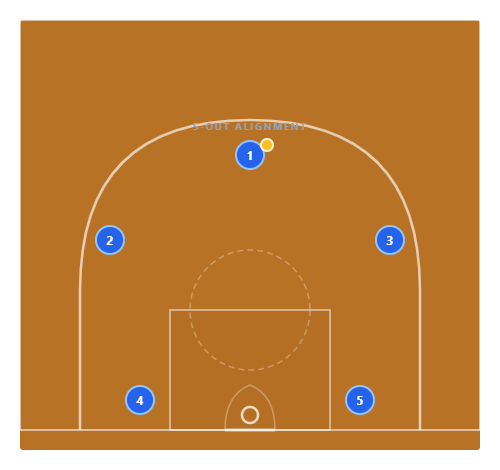
Initial Alignment : Five players spaced around the arc in a “5-out” formation. This creates maximum spacing, opens driving lanes, and forces the defense to guard the entire perimeter. The point guard initiates with a pass to either wing.
Offense
Ball
Pass & Cut :The fundamental rule: every time you pass, you cut. 1 passes to 2 and basket-cuts to the rim. If 2 can hit 1 on the cut, it’s a layup. If not, 1 clears to the opposite corner and the offense resets with new spacing.
Offense
Ball
Fill & Screen Away: After 1 clears, 5 fills the top. 2 swings to 5 — this ball reversal shifts the entire defense. Meanwhile, 1 sets a down screen for 4. This constant screening and filling creates mismatches and open shots in the natural flow.
Offense
Ball
Continuous Motion : The beauty of motion: it never stops. 5 has the ball on top and reads: pass to 4 or 3 on the wings, drive the gap, or hit 2 flashing to the high post. Every pass starts another cycle of cuts, screens, and reads. The defense can’t rest.
1
Spacing
18 feet between all players at all times
2
Ball Reversal
Swing the ball side to side to shift the defense
3
Read & React
Every pass triggers a cut, screen, or fill
4
Pace
Move with purpose — never stand still for more than 1 second
Who Runs It
Nearly every D1 program uses elements of motion offense. Tony Bennett's Virginia "Mover-Blocker," Scott Drew's Baylor, and Tom Izzo's Michigan State all build from this foundation.
Best Against
Motion is most effective against man-to-man defense. The constant cutting and screening creates mismatches and forces defenders to make tough decisions on every possession.
Weakness
Requires all 5 players to read and react in sync. One player who hesitates or doesn't cut disrupts the entire flow. Teams with poor basketball IQ struggle to execute motion.
02
Horns
1-2-2
Ball Screen
Versatile
A 1-2-2 set with two bigs at the elbows (“horns”). From here, the offense can flow into ball screens, handoffs, isolations, or post-ups — making it the most versatile starting alignment in college basketball.
Tony Bennett’s signature at Virginia. All four off-ball defenders position themselves inside an imaginary “pack line” 16 feet from the basket, clogging driving lanes and forcing the offense to shoot contested jumpers over a wall of bodies.
Offense
Ball
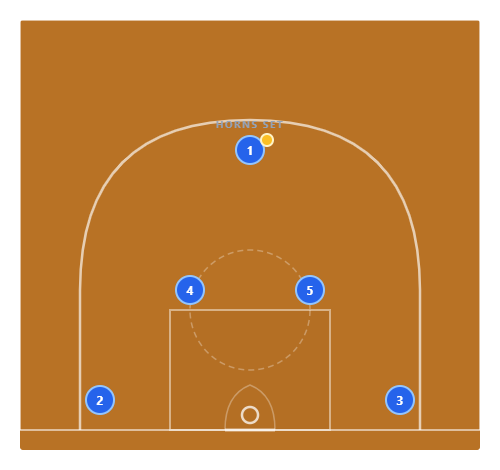
Horns Alignment : 1 has the ball up top. 4 and 5 are at the elbows (free-throw line extended). 2 and 3 are in the corners. This creates a balanced floor with multiple immediate actions available — the defense doesn’t know what’s coming.
Offense
Ball
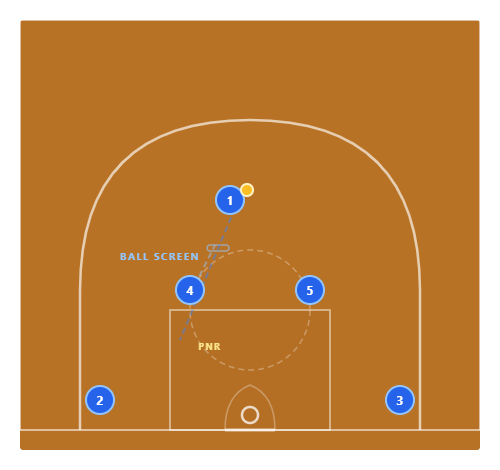
Option A — Reads :4 steps up and sets a ball screen for 1. 1 uses the screen and attacks downhill. 5 spaces to the weak side. 4 rolls to the rim after screening. The defense must decide: switch (creates a mismatch), hedge (1 rejects), or go under (1 shoots).
Offense
Ball
Closeout & Recover : After the screen, 4 has the ball at the elbow. Read time: pass to 2 in the corner (if the baseline help left), hit 5 popping to the wing, or feed 4 rolling to the rim. The high post is the decision-maker — exactly like zone offense.
Offense
Ball
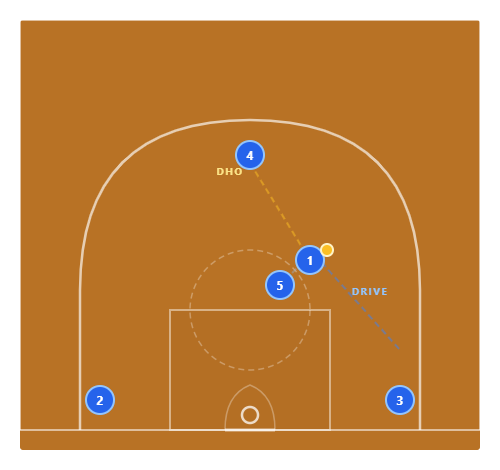
Option B — Dribble Handoff : Instead of a ball screen, 1 passes to 5 and cuts through. 5 hands the ball to 1 on the move (DHO). 1 attacks off the handoff with a full head of steam. This is a staple of programs like Gonzaga — the handoff creates a clean driving angle.
1
Elbows
Two bigs at the free-throw line elbows are the keys
2
Options
Ball screen, DHO, or post-up from the same look
3
Reads
Point guard reads the defense to pick the best option
4
Mismatch
Create switches to hunt favorable matchups
Who Runs It
Gonzaga (Mark Few) and Duke are known for their Horns sets. It's also a go-to alignment in the NBA because of its versatility.
Best Against
Equally effective against man and zone. Against man, it creates screen/roll actions. Against zone, the elbows occupy the soft spots of a 2-3.
Weakness
Requires skilled bigs who can pass, screen, and make decisions at the elbows. If your 4 and 5 can only catch and dunk, Horns loses its versatility.
03
High-Low
2-Post
Inside-Out
Power Game
A traditional power offense that establishes position in the high post and low post, then works the ball inside-out. When you have two skilled bigs, this offense is brutally efficient and nearly impossible to stop.
Offense
Ball
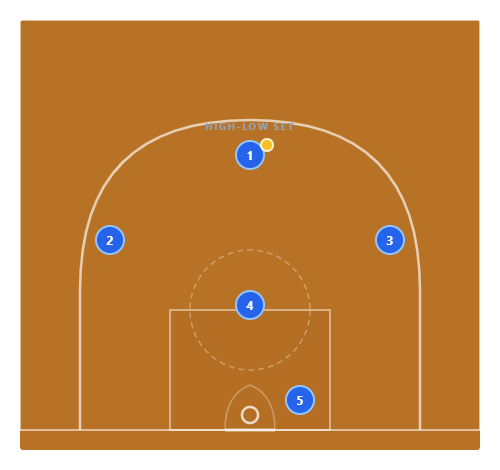
Alignment : 4 is at the high post (free-throw line). 5 is on the low block. Guards are spaced on the wings and top. This two-post alignment forces the defense to make a choice: guard the high post or protect the rim. They can’t do both well.
Offense
Ball
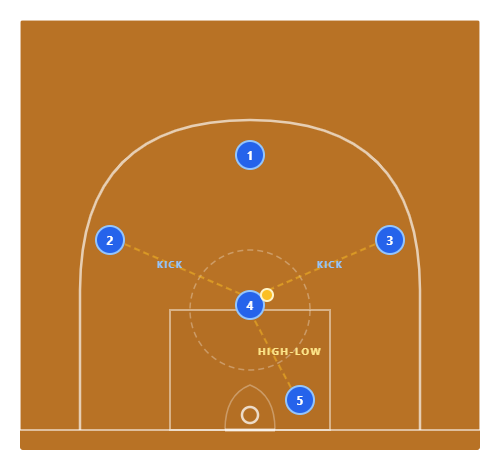
High Post Entry :1 passes to 4 at the free-throw line. This is the trigger. The moment 4 catches, the defense collapses — help defenders sag toward the paint to protect the rim. 4 must catch, face the basket, and read instantly. Every second of hesitation lets the defense recover.
Offense
Ball
The Read : 4 has three reads: (1) Drop it to 5 on the block for a point-blank layup — the classic “high-low” pass. (2) Kick to 2 or 3 on the wing if their defenders helped inside. (3) Shoot the mid-range jumper if the defense sags. The high post player with vision is unstoppable here.
Offense
Ball
Low Post Score or Kick : If 5 catches on the block, they can finish with a post move, or — if the defense sends a double team — kick to the open man on the perimeter for an open three. The inside-out game is lethal because the defense is always one step behind.
1
Establish
Get the ball inside before going outside
2
Patience
Work for the highest-percentage look
3
Seal & Feed
Bigs must seal their defender and demand the ball
4
Kick
When the defense collapses, kick to open shooters
Who Runs It
Kansas under Bill Self is the gold standard. Purdue with Zach Edey dominated using high-low concepts. Any team with two quality bigs can run this.
Best Against
Destroys smaller lineups and zones. The 2-3 zone is especially vulnerable because the high post sits in its biggest gap.
Weakness
Requires at least one skilled passing big. Also struggles against elite shot-blockers who can cover both the high and low post simultaneously.
04
Dribble Drive Motion
4-Out 1-In
Dribble-Heavy
Tempo
Made famous by John Calipari at Memphis and Kentucky. The DDM spreads the floor with four perimeter players and one big, then attacks via dribble penetration. Speed, athleticism, and driving ability are the weapons.
Offense
Ball
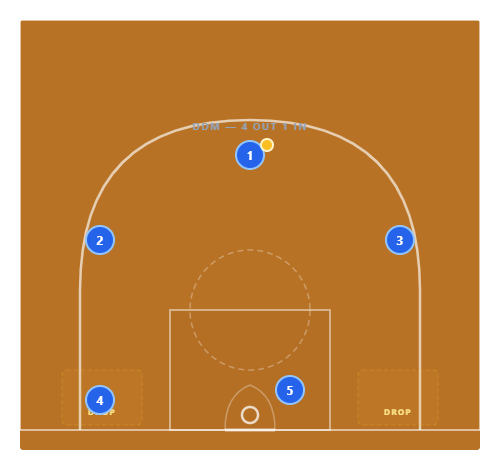
DDM Alignment : Four players spaced outside the arc. 5 is on the block or short corner. The two baseline corners are “drop zones” — when a player drives, the nearest corner player drops to the baseline, ready for the kick-out. The floor is wide open for dribble penetration.
Offense
Ball
Attack the Gap :1 drives aggressively into the lane off the dribble. There’s no screen needed — the spacing creates the lane. As 1 drives, 4 drops to the baseline corner (the “drop zone”). The defense must commit a help defender to stop the drive — and that creates the open man.
Offense
Ball
Kick to the Drop Zone : 1 draws help and kicks to 4 in the corner for an open three. Or, if the defense rotates to 4, 1 skips the ball to 3 on the opposite wing. The drive creates a chain reaction — help rotates, and the offense stays one pass ahead.
Offense
Ball
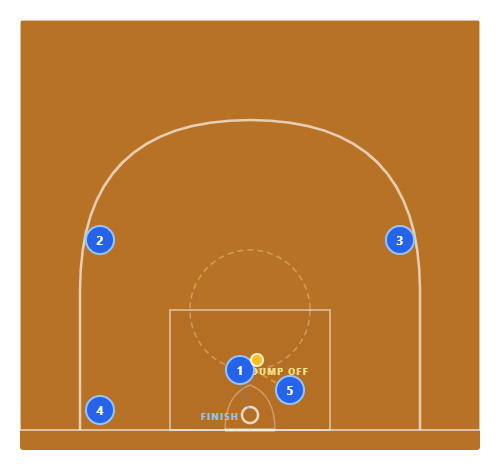
Finish or Dump : If 1 beats the help defender, finish at the rim. If a big steps up, dump to 5 on the block for an easy bucket. The DDM is constant, relentless attacking — the defense is always reacting, never proactive.
1
Spread
4-out spacing creates maximum driving lanes
2
Attack
Every touch is an opportunity to drive
3
Drop Zone
Two "drop zones" at the baseline corners
4
Kick & Swing
Drive draws help → kick for open threes
Who Runs It
John Calipari (Kentucky/Arkansas), Vance Walberg (who created it). Many up-tempo programs use DDM principles with their own tweaks.
Best Against
Man-to-man defense, especially against slow-footed defenders. The spread floor exposes any defender who can't stay in front of their man.
Weakness
Requires elite drivers. If your guards can't beat their man off the dribble, the entire system breaks down. Also generates a lot of 3-point attempts, which can go cold.
05
Flex Offense
Continuity
Screens
Equalizer
A structured continuity offense built on staggered screens and baseline cuts. The same pattern repeats continuously, creating layups and open mid-range shots through precise screening. The great equalizer — it doesn’t need stars.
Offense
Ball
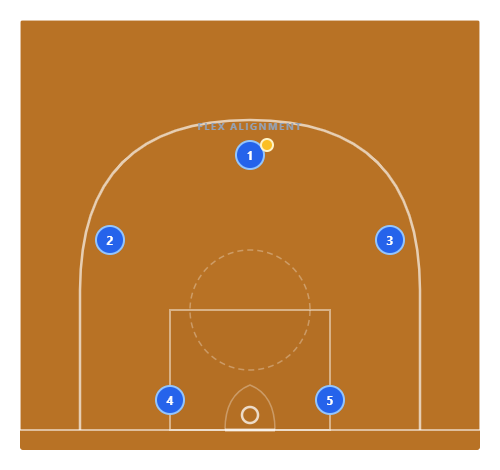
Flex Alignment : Guards up top and on the wings, bigs on the blocks. Simple, balanced, and the starting point for the continuous flex pattern. Every player will play every position as the offense cycles through.
Offense
Ball
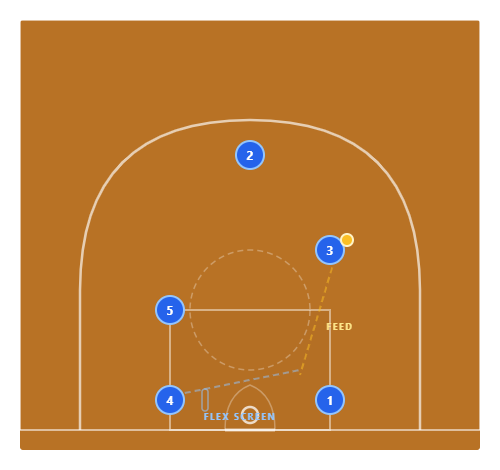
The Flex Cut :1 passes to 2 on the wing. 5 sets a “flex screen” across the baseline for 4. 4 uses the screen and cuts across the lane to the opposite block — this is the signature move. If 4 is open on the cut, 2 feeds them for a layup.
Offense
Ball
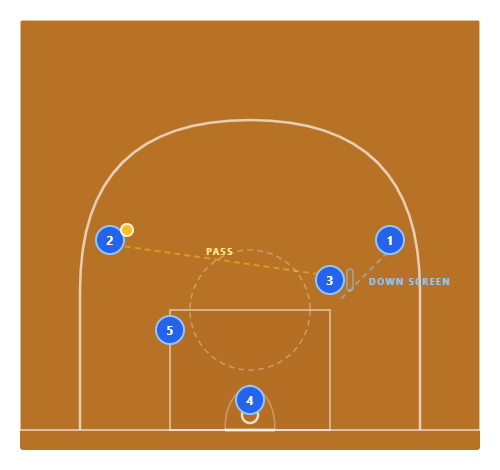
Down Screen & Reset : After 5 screens for 4, 1 sets a down screen for 3. 3 pops to the wing. 2 passes across to 3 — and now the flex pattern is set up on the OTHER side of the floor. The entire action repeats, continuously, from side to side.
Offense
Ball
Continuous Cycle : Now 5 sets a flex screen for 1, 1 cuts across the baseline — the same pattern, mirrored. This repeats indefinitely until someone gets an open shot. The beauty: every player gets scoring opportunities. The defense can’t key on one player because everyone runs the same actions.
1
Flex Cut
Baseline screen → basket cut for a layup
2
Down Screen
After passing, screen down to reset
3
Continuity
The pattern repeats seamlessly from both sides
4
Discipline
Set every screen with purpose — no lazy screens
Who Runs It
Bo Ryan's Wisconsin was the gold standard. Many mid-major programs love Flex because it maximizes execution over talent.
Best Against
Effective against man-to-man. The constant screening forces defenders to fight through or switch, both of which create openings.
Weakness
Predictable by design. Elite defenders can jump the flex cut. Also can be slow — doesn't generate easy transition baskets.
06
Princeton Offense
Backdoor
High Post
Patient
An elegant, cerebral offense built on backdoor cuts, ball fakes, and a dominant high-post playmaker. The Princeton Offense values IQ over athleticism and generates layups through deception, not speed.
Offense
Ball
Princeton Set : 5 is at the high post — the most important position. Guards are spread on the perimeter. The offense starts by passing to the wing and reading the defense. The key: watch your defender. If they deny the pass, you cut backdoor. If they sag, you receive the ball and look inside.
Offense
Ball
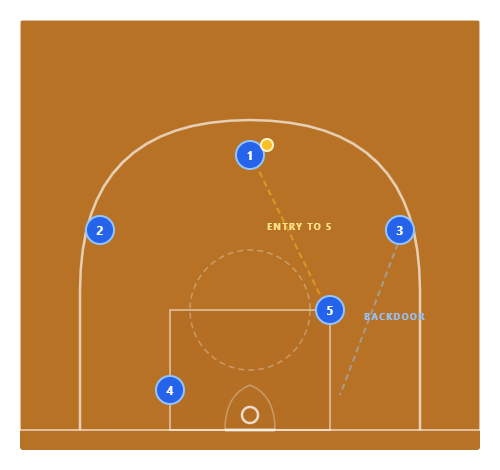
Entry & Backdoor :1 passes to 5 at the high post. 3’s defender turns their head to watch the ball — that’s the cue. 3 immediately cuts backdoor. 5 hits 3 with a bounce pass for a layup. This is the Princeton Offense in its purest form: one pass, one read, one cut.
Offense
Ball
Wing Entry — High-Low : 2 passes to 5 at the elbow. 5 looks inside to 4 on the block (high-low). If 4 is sealed, that’s a layup. If not, 1 cuts through the lane looking for a return pass. The defense is pulled in multiple directions — somebody is open.
Offense
Ball
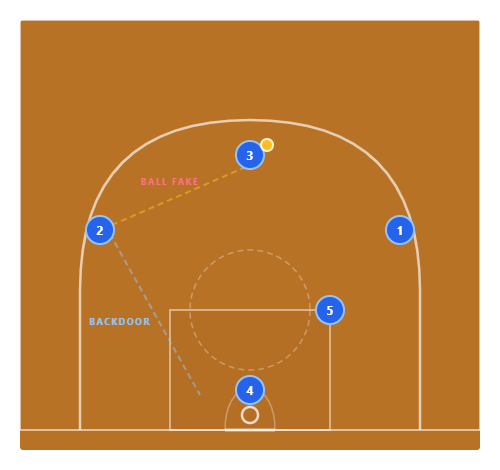
The Art of the Fake : 3 ball-fakes a pass to 2 on the wing. 2’s defender reacts to the fake and jumps the passing lane — but the pass never comes. 2 immediately cuts backdoor. 3 throws a lob for a layup. The entire Princeton system is built on this principle: make the defense commit, then punish them.
1
Patience
Run the clock, read the defense, wait for the perfect cut
2
Backdoor
If your defender overplays, go backdoor for a layup
3
High Post
The 5 at the high post is the QB of the offense
4
Fakes
Ball fakes and eye fakes set up every cut
Who Runs It
Pete Carril invented it at Princeton. Today, coaches like Mitch Henderson (Princeton) and many Ivy League programs still run it. Elements appear in virtually every modern offense.
Best Against
Devastates aggressive, overplaying man-to-man defense. The more the defense denies, the more backdoor layups are available.
Weakness
Requires exceptional patience and IQ. Can look stagnant if players don't read correctly. Shot clock can become an issue if cuts aren't crisp.
07
Swing Offense
Ball Reversal
Continuity
Simple
A simple, repeatable system built on ball reversals and the “swing” pass. The ball moves from one side of the floor to the other, creating open shots through constant side-to-side motion. Easy to learn, hard to defend.
Offense
Ball
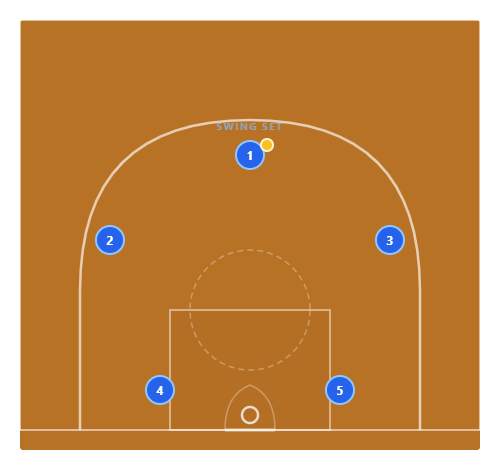
Swing Alignment : A standard 1-4 high or 2-3 alignment. The positions don’t matter as much as the rules. The system is defined by ball movement, not positions — that’s what makes it easy to teach and hard to scout.
Offense
Ball
Pass & Screen Away :1 passes to 2 and screens away for 5 (or any off-ball player). 5 uses the screen and pops to the wing. Meanwhile, 4 steps up. The ball will now “swing” from 2 to the top to the opposite side.
Offense
Ball
Passing Lane Denial : The three non-trapping defenders don’t guard their man — they guard the passing lanes. X4 jumps into the lane between the ball and the nearest outlet. X3 denies the middle of the floor. X5 shades toward the ball-side deep outlet. If the trapped player throws a lob or a lazy pass, it’s a steal and a fast break.
Offense
Ball
Attack on the Catch : 3 catches the swing pass and attacks immediately — the closing defender is off balance. If the lane is open, drive. If help comes, pass to 2 who has relocated, or kick to 5 in the corner. The offense resets and swings back the other way. Continuous, relentless ball movement.
1
Swing It
The ball must touch both sides of the floor every possession
2
Drive on Catch
Every swing pass is an opportunity to attack a closing defender
3
Screen Away
Off-ball players screen for each other after every pass
4
Simplicity
Just 2-3 rules — anyone can run it on day one
Who Runs It
Originally popularized at the high school level, the Swing is now widely used by mid-major college programs. Bo Ryan used elements of it at Wisconsin alongside Flex.
Best Against
Man-to-man defense. Ball reversal forces defenders to constantly close out, creating driving lanes and open catch-and-shoot opportunities.
Weakness
Can become predictable if the ball doesn't move quickly enough. Also, elite defensive teams can "shadow" the swing and take away the catch-and-drive.
08
Blocker-Mover
Pack Line
2 Roles
Spacing
Tony Bennett’s signature at Virginia. Players are divided into two roles: “Movers” (guards who cut and use screens) and “Blockers” (bigs who set screens and space). The system generates open looks through constant off-ball screening action.
Offense
Ball
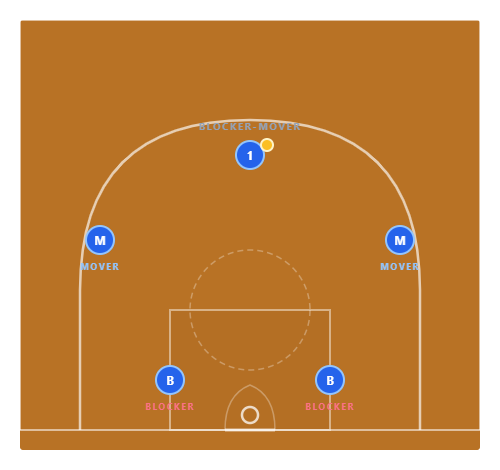
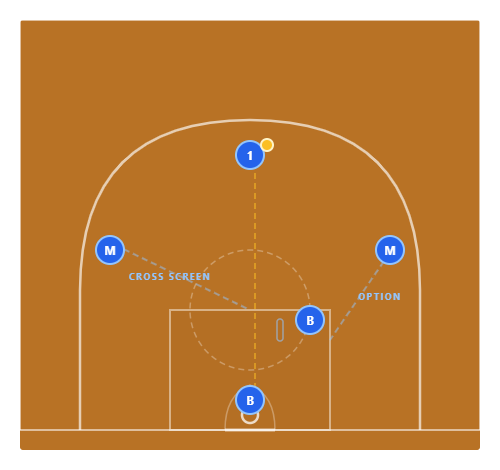
Roles Defined: : Two “Movers” (typically guards) are on the wings — they cut, use screens, and look to score. Two “Blockers” (typically bigs) are on the blocks — they set screens and create space. The point guard reads the defense and initiates.
Offense
Ball
Action 1 — Pin Down :1 passes to Mover on the wing. The ball-side Blocker sets a pin-down screen. The Mover curls off the screen toward the basket. If the curl is open — layup. If not, the Mover pops out and the ball reverses.
Offense
Ball
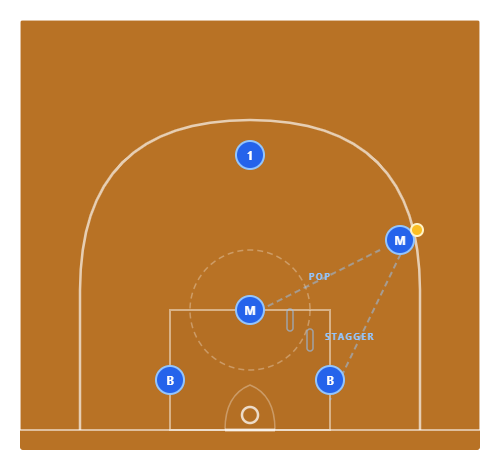
Action 2 — Stagger Screens : Both Blockers set staggered screens for the Mover. The Mover reads the defense: curl tight for a layup, pop to the wing for a three, or reject the screen and go backdoor. Three options from one simple action — the defense guesses wrong constantly.
Offense
Ball
Continuous Action :The screening never stops. Blockers cross-screen for each other. Movers weave through the screens. 1 reads from the top and delivers the ball to whoever is open. Virginia held the ball for 25+ seconds per possession using this system — and won a national title doing it.
1
Switch All
Every screen triggers a switch — no exceptions
2
Versatility
All 5 defenders must guard 1-through-5
3
Communication
"Switch!" must be called early and loud
4
No Mismatches
If everyone can guard everyone, there are no mismatches to hunt
Who Runs It
Baylor under Scott Drew used switching principles to win the 2021 title. Houston under Kelvin Sampson. Texas Tech. Any team with versatile, athletic defenders.
Best Against
Ball-screen-heavy offenses and pick-and-roll teams. If every screen is switched cleanly, the PnR generates zero advantage.
Weakness
Requires a rare roster — all five players must guard all positions. A true 7-footer or a very small guard can be exploited in switches. Also vulnerable to great post-up players who can isolate a guard switch.
09
Junk / Box-and-1
Ball Screen
Guard-Driven
Modern
The most dominant action in modern basketball at every level. The point guard uses a ball screen from a big, reads the defense, and makes a play. Simple in concept, infinitely complex in execution.
Offense
Ball
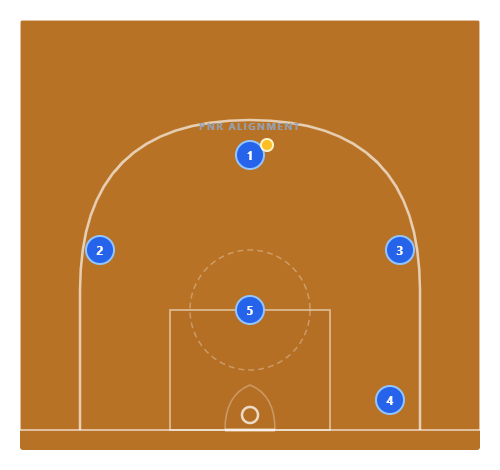
PnR Set : Point guard up top with the ball. The screener (5) is at the elbow or high post. Three shooters are spaced: two wings and a corner. This 1-4 spacing gives maximum room for the ball screen action and surrounds the defense with shooting threats.
Offense
Ball
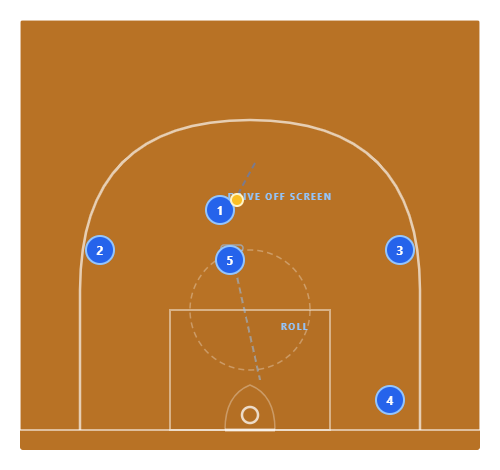
Ball Screen & Roll :5 sets a ball screen at the top. 1 drives off the screen toward the elbow. 5 immediately rolls to the rim after screening. The defense has a choice: (1) stay attached and get screened, (2) switch and give up a mismatch, (3) hedge and recover, or (4) drop and give up a pull-up.
Offense
Ball
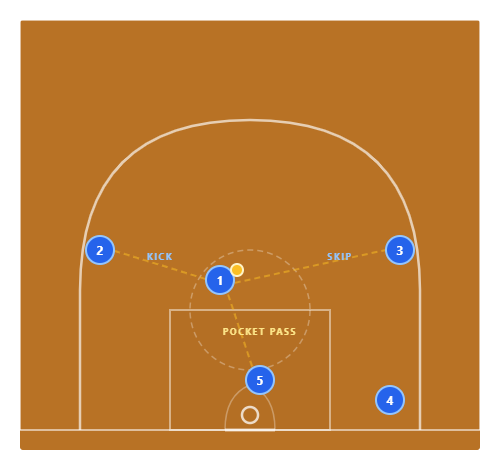
The Reads : 1 is in the paint with the ball. Reads: (1) Pocket pass to 5 rolling to the rim — the highest-value pass in basketball. (2) Kick to 2 on the wing if help came from the left. (3) Skip to 3 or 4 if the entire defense collapsed. (4) Score it yourself if the lane is open.
Offense
Ball
Pop Option : If the defense drops (big stays back), 5 can “pop” to the arc instead of rolling. 1 pulls up for a mid-range jumper, or kicks to 5 for an open three. Modern PnR offenses use the pop to punish drop coverage. A 5 who can shoot threes makes this action nearly unguardable.
1
Screen Angle
The angle of the screen dictates the play — flat, angled, or re-screen
2
Read the D
Drop, switch, hedge, blitz — each coverage has a counter
3
Spacing
Other 3 players must be spaced and ready to shoot
4
Two-Man Game
PnR is a 2-man game that becomes 5-man when help rotates
Who Runs It
Every program runs PnR. Houston under Kelvin Sampson uses it as the primary action. UConn's 2023-24 championship team was PnR-heavy. It's the universal foundation of modern basketball.
Best Against
Everything. PnR has counters for every defensive coverage — drop, switch, hedge, blitz, ice, and veer. The question isn't if it works, it's which read to make.
Weakness
Requires a guard who can read coverages and a big who can screen, roll, and finish (or pop and shoot). Poor decision-making in PnR leads to turnovers.
10
Secondary Break
Tempo
Fast Break
Early Offense
The offense that starts before you even set up. The secondary break is the structured action immediately after a rebound or made basket — the organized chaos between the fast break and the half-court set. Score before the defense gets set.
Offense
Ball
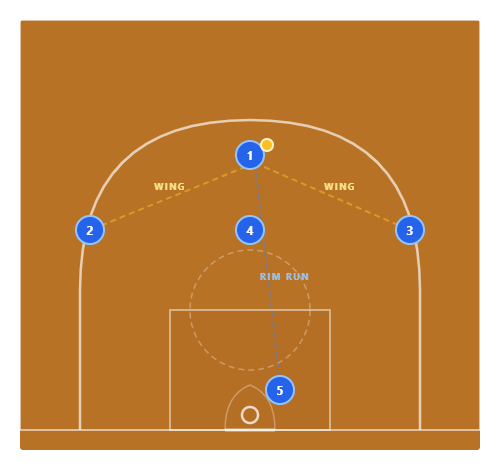
The Break : 1 pushes the ball up the floor immediately. 2 and 3 are the “wings” — they sprint to fill the wide lanes along the sidelines. They must be ahead of the ball. 4 is the “trailer” — they arrive at the top of the key 1-2 seconds after the ball. 5 is the “rim-runner” — they sprint straight to the basket.
Offense
Ball
Numbers Advantage :1 crosses half court and reads: if 5 has beaten their defender down the floor, throw the lob for a layup. If a wing (2 or 3) is ahead of the defense, hit them in stride for a transition three. The first 3 seconds after crossing half court are the most valuable scoring window.
Offense
Ball
Trailer Action : If no numbers advantage, 1 passes to 4 trailing at the top of the key. 4 can: (1) Shoot the open three if the defense hasn’t recovered. (2) Swing to a wing. (3) Enter to 5 posting up before their defender is set. The trailer three is one of the most efficient shots in basketball.
Offense
Ball
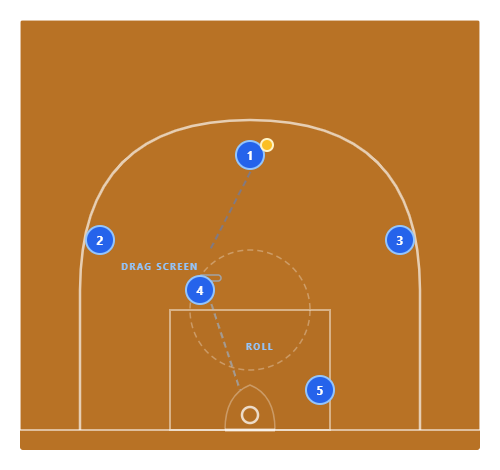
Flow into Half Court :If nothing opens in the secondary break, 4 sets a “drag screen” (a ball screen in transition). 1 uses it and the offense flows seamlessly into PnR action without stopping. The defense never gets a chance to set up — they’re defending the break AND the half-court offense at the same time.
1
Push
The ball must cross half court in under 4 seconds
2
Fill Lanes
3 wide lanes: ball, rim-runner, and trailer
3
Numbers
Attack if you have a numbers advantage (3v2, 2v1)
4
Flow
If no advantage, flow seamlessly into the half-court set
Who Runs It
North Carolina under Hubert Davis, Kansas under Bill Self, and most up-tempo programs prioritize the secondary break. UConn's back-to-back titles were built on elite transition offense.
Best Against
Everything — it attacks before the defense is organized. Especially effective against pressing teams who over-commit and leave the back end exposed.
Weakness
Requires excellent conditioning and fast decision-making. Can lead to sloppy turnovers if players rush. Also: you need to GET the rebound first.