Interactive guide to attacking full-court and half-court press defense. Stay composed, find the outlets, and turn their pressure into your fast break.
Know What You're Facing
The first step is recognizing the press type. Click each to see the formation and pressure points on a full court.
🔵 Offense
🔴 Press Defense
⚡ Trap Zones
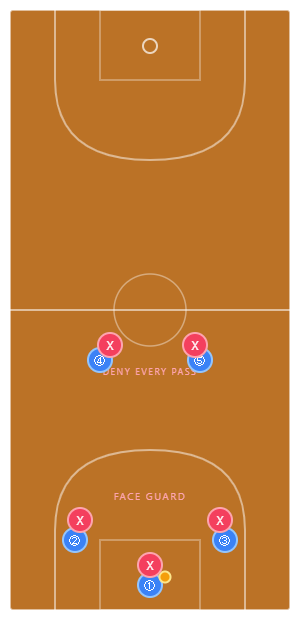
Man-to-Man Press: Every defender is matched up and denying their man. The ball handler is pressured the length of the floor. Beat it with hard cuts, backdoor releases, and screens for the inbounder. Use change of speed — jog, then explode.
🔵 Offense
🔴 Press Defense
⚡ Trap Zones
1-2-2 Press: One defender pressures the inbound, two sit at the free-throw line extended, two more guard the backcourt. They want to trap along the sideline. Beat it by getting the ball to the middle — the gaps between the 1 and the 2s are wide open. Use the inbounder as an outlet after passing in.
🔵 Offense
🔴 Press Defense
⚡ Trap Zones
2-2-1 Press: The most common zone press in college basketball. Two defenders trap the inbound area, two more set traps near half court, one safety protects the basket. The trap happens immediately after the inbound. Beat it by passing quickly — the ball should touch the middle of the court within 2 passes. Never dribble into the corner.
🔵 Offense
🔴 Press Defense
⚡ Trap Zones
1-2-1-1 Diamond Press: The most aggressive zone press. The point man funnels the ball handler to a sideline where a wing trapper ambushes. The middle defender denies the middle pass. Beat it by reversing the ball quickly to the weak side — the diamond rotates slowly against fast reversals. The deep safety is alone — if you get behind the trap, it’s 2-on-1.
1
Don't Panic
The press wants you to rush. Slow your brain, not your feet.
2
See the Floor
Eyes up, chin up. Dribbling with your head down = turnover.
3
Meet the Pass
Never stand still. Sprint toward every pass to cut off deflections.
4
Attack
A broken press = numbers in transition. Turn defense into offense.
5
Use the Middle
The middle of the floor is the press-breaker. Sidelines are traps.
Full-Court Press Break Sets
Proven press-break alignments used by top college programs. Click a set, then step through the action.
🔵 OFFENSE
🔴 PRESS
🟡 BALL
1-4 Stack — Setup: All four receivers line up in a stack at the free-throw line extended. This is simple and effective. On a signal, they break in four different directions, creating confusion for the press and giving the inbounder multiple options.
🔵 OFFENSE
🔴 PRESS
🟡 BALL
1-4 Stack — Break: On the inbounder’s signal, 2 and 3 sprint to the sidelines as short outlets. 4 and 5 cut to the wings at half court as deep outlets. The inbounder reads: pass to whoever is open. If the press denies the short pass, go over the top to 4 or 5.
🔵 OFFENSE
🔴 PRESS
🟡 BALL
1-4 Stack — Advance: 2 catches the inbound and immediately looks to the middle of the floor — 4 is the release valve. Once the ball hits the middle, the press is beaten. 4 catches, turns, and finds 5 sprinting up the far sideline. The inbounder (1) trails as a safety option. Attack!
🔵 OFFENSE
🔴 PRESS
🟡 BALL
Diamond — Setup: A 1-2-1-1 alignment mirrors the diamond press. 2 and 3 are the short outlets on each wing. 4 sits in the middle of the backcourt — the KEY position. 5 is deep at half court. The inbounder reads the press and picks the right pass.
🔵 OFFENSE
🔴 PRESS
🟡 BALL
Diamond — Entry: 2 catches the inbound and is immediately pressured toward the sideline. Before the trap arrives, 2 passes to 4 in the middle of the floor. The middle man is the press-breaker — once the ball is in the middle, the defense is scrambling.
🔵 OFFENSE
🔴 PRESS
🟡 BALL
Diamond — Attack: 4 catches in the middle and faces up court. Reads: if 5 is open deep, fire it long — the press is behind you. If the safety (X5) covers, swing to 3 on the wing. 1 and 2 trail to fill lanes. A broken press should become a 3-on-2 or 4-on-3 fast break.
🔵 OFFENSE
🔴 PRESS
🟡 BALL
Spread — Setup: Four receivers spread to the four quadrants of the backcourt — two short, two deep. This stretches the press to its maximum width and depth. The inbounder picks the most open quadrant and fires. Simple, hard to deny.
🔵 OFFENSE
🔴 PRESS
🟡 BALL
Spread — Setup: Four receivers spread to the four quadrants of the backcourt — two short, two deep. This stretches the press to its maximum width and depth. The inbounder picks the most open quadrant and fires. Simple, hard to deny.
🔵 OFFENSE
🔴 PRESS
🟡 BALL
Spread — Advance: 2 catches and looks to advance immediately. The sideline pass to 4 is the fastest route — straight up the sideline, ahead of the press. Or 2 hits the middle of the floor if the sideline is denied. Once past half court, push the pace — the press is behind you and scrambling to recover.
🔵 OFFENSE
🔴 PRESS
🟡 BALL
Tandem — Setup: 2 and 3 set a staggered double screen near the free-throw line for each other. On the inbound, one pops to the ball-side sideline, the other breaks to the middle. 4 is at half court, 5 is the deep outlet. The screens free up the short outlets.
🔵 OFFENSE
🔴 PRESS
🟡 BALL
Tandem — Screen & Break: 3 screens for 2. 2 pops to the sideline, 3 cuts to the middle. The press defenders are caught in the screen and can’t recover quickly. The inbounder hits whichever cutter is open — sideline or middle.
🔵 OFFENSE
🔴 PRESS
🟡 BALL
Tandem — Chain Pass: 2 catches and hits 3 in the middle (relay). 3 catches and pushes forward to 4. 4 turns and finds 5 streaking ahead. Three quick passes break the press — the ball moves faster than defenders can shift. 1 trails as the safety valve.
Inbound is Everything
A clean inbound pass is 80% of the battle. The inbounder should never throw across the baseline — always pass up the sideline or to the middle. If nobody's open, call timeout before forcing it.
Middle = Safety
The middle of the floor is the press's blind spot. Get the ball to the middle and you can see both sides of the court. Sideline + baseline = corner = trap. Stay out of corners.
Pass > Dribble
A pass moves faster than any dribble. Against a press, prefer the pass. Dribble only to advance into space or escape a trap — never dribble into traffic.
Beating Half-Court Traps
When the press picks you up at half court or sets traps in the front court, the principles shift. Click each trap scenario.
🔵 OFFENSE
🔴 PRESS
🟡 BALL
Wing Trap: Two defenders trap the ball on the wing — the on-ball defender and a helper (usually from the top of the zone). Escape options: overhead pass to the point guard at the top, bounce pass to the corner/baseline, or skip pass to the weak side. The key: pivot, protect, and read before the trap fully closes.
🔵 OFFENSE
🔴 PRESS
🟡 BALL
Corner Trap: The deadliest trap location — you have the baseline and sideline as extra defenders. The ball handler has limited angles. Escape: strong overhead pass back to the wing, or a cross-court skip pass if you can see it. Best answer: don’t get trapped in the corner in the first place. Catch and face before the second defender arrives.
🔵 OFFENSE
🔴 PRESS
🟡 BALL
High Elbow Trap: When the ball is received at the elbow/free-throw area, the defense traps from the top and side. This is actually the best place to GET trapped — because you can see the whole court. Pivot, face the basket, and read: kick to either wing, drop to either block, or shoot over the trap if you’re a big with touch.
🔵 OFFENSE
🔴 PRESS
🟡 BALL
Timeline Trap: The defense traps as you cross half court — using the timeline as a third defender (backcourt violation). Two defenders jump the ball right at the line. Beat it: cross half court with speed and change direction immediately. Or pass across half court before you arrive — let a teammate catch it in the front court and avoid the trap entirely.
Split the Trap
If you're athletic and decisive, dribble through the gap between two trappers before they close. This requires a low, hard dribble and a burst of speed. High-risk, high-reward.
Pivot & Protect
When trapped, use a reverse pivot to shield the ball with your body. Keep two hands on the ball, eyes up. Find the open man — there's always one because two defenders are on you.
Practice Drills
Build press-break confidence through repetition. Click to expand each drill.
01 2-on-1 Full Court Advance
Two offensive players vs. one defender, full court
Ball starts under the basket after a made shot — inbounder must find the open man
Offense must advance past half court within 6 seconds
Defender can play any style: deny, funnel sideline, or front the ball
Focus: quick inbound, meeting the pass, and using the middle of the floor
10 reps, then switch roles
02 3-on-3 Trap & Escape
3 offensive players vs. 3 defenders in the backcourt
Defense runs a 2-1 zone press — two trap the ball, one denies the middle
Offense must advance across half court without a turnover
After crossing half court, it's live 3-on-3 to a finish
Teaches: pivot under pressure, pass over the trap, and attacking after the break
Play to 7 — turnover = point for defense
03 5-on-5 Press Break — 8 Seconds
Full 5-on-5. Defense runs a 2-2-1 full-court press
Offense has 8 seconds to advance (stricter than the 10-second rule)
If offense breaks the press and scores in transition, it counts as 3 points
If defense forces a turnover or 10-second violation, they get 2 points
Rotate press styles every 5 reps: man press, 2-2-1, 1-2-2, diamond
First team to 15 wins
04 Gauntlet: Full-Court 1-on-2
One ball handler vs. two defenders — full court
Ball handler must get across half court and score
Defenders trap at the sideline and near half court
Teaches: composure under extreme pressure, change of pace, and dribble moves
If the ball handler scores, they stay on — if not, rotate
Best for guards; builds mental toughness in high-pressure moments
05 Inbound Under Fire
Inbounder + 4 teammates vs. 5 pressing defenders after a made basket
Defense applies maximum deny pressure — no easy inbound
Offense has 5 seconds to inbound (regulation rule). If they can't, it's a turnover
Practice every inbound option: sideline, lob, screen for the inbounder
Critical drill before facing press-heavy teams (VCU, Arkansas, West Virginia style)
10 reps from each baseline, track success rate
By the Numbers
Why beating the press is one of the most valuable skills in college basketball — and why so many teams struggle with it.
Press TO Rate (Unprepared)
~28%
Press TO Rate (Prepared)
~12%
PPP After Breaking Press
~1.22
PPP After Press TO
~1.18
Avg Press Usage (D1)
~20%
Transition Pts Off Break
~8/gm
16% Turnover Gap
Unprepared teams turn it over ~28% against press defense. Teams that drill press breaks cut that to ~12%. That's 5–6 fewer turnovers per game — often the margin between winning and losing.
1.22 PPP Goldmine
Breaking the press creates transition opportunities worth ~1.22 points per possession — among the highest-efficiency situations in basketball. The press is a gamble, and when it fails, you should make them pay.
The Fatigue Factor
Press teams expend massive energy. If you break the press consistently through the first half, the pressing team's defense degrades significantly in the second half. Patience beats pressure.
10-Second Killers
About 15% of turnovers against press defense are 10-second violations or backcourt traps — not steals. Simply advancing the ball calmly eliminates a huge chunk of press-caused turnovers.