14 drills that build elite passers — from fundamental two-ball handling to full-speed 5-on-0 transition breaks. The playbook every college program uses to develop vision, timing, and precision.
Fundamental Passing
Every great passer starts here. These drills build the mechanics, hand strength, and decision-making speed that make every other passing drill possible.
5
Min
50+
Passes
2
Players
Stationary
Type
Low
Intensity
Passer Target● Ball
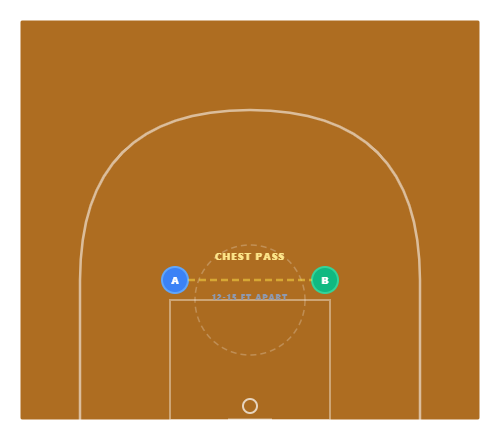
Chest Pass : Partners face each other 12-15 feet apart. Step into the pass, extend both arms, snap the wrists — thumbs turn down, fingers point at the target. The ball should arrive at your partner’s chest with zip and backspin. 20 reps each. This is the most common pass in basketball — it must be automatic, crisp, and accurate every single time.
Passer Target● Ball
Bounce Pass : Same setup. Push the pass toward the floor — the ball should bounce at the 2/3 mark (closer to your partner than to you) and arrive at their waist or below. Step into it. Wrists snap. The bounce pass is the primary entry pass in half-court offense — it goes under the defender’s hands. 20 reps each. Focus: the ball hits the floor at the correct spot every time.
Passer Target● Ball
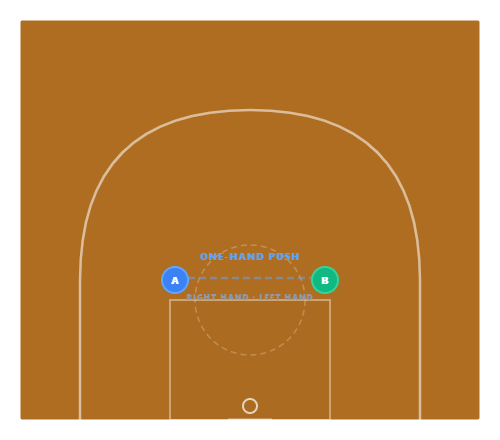
One-Hand Push Pass : Pass with one hand — like a shot-put motion. Ball in the right hand, step with the left foot, push the ball directly to the target. Then switch: left hand, step with the right foot. 10 reps each hand. The one-hand push pass is used in traffic, in the post, and in transition when you need to pass around a defender. Both hands must be equally strong and accurate.
Coaching Points
1 Step INTO every pass — the power comes from your legs, not your arms
2 Snap the wrists at the end: thumbs down, fingers point at the target’s chest or numbers
3 The ball should have backspin on chest passes and bounce passes — backspin = accuracy
4 One-hand passes: keep the off-hand behind the ball as a guide until the very last moment
5 Partners should give a hand target — “show me where you want the ball”
6 Bad passes start bad habits. If the pass is off-target, correct immediately — don’t accept sloppy reps.
Why Fundamentals
Over 60% of turnovers in college basketball come from passing errors — bad angles, weak passes, and telegraphed decisions. The chest, bounce, and push pass are the three passes you’ll throw 95% of the time. Make them flawless.
Hand Strength
College players should be able to pass crisply with either hand from 20+ feet. If your left hand is weak, you’re limited to passing right — and the defense will take that away. Two-hand drills build two-hand players.
5
Min
40+
Passes
2
Players
Stationary
Type
Medium
Intensity
Passer Target● Ball
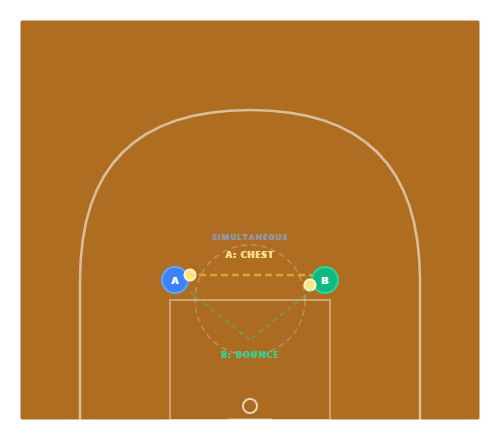
Simultaneous Two-Ball : Both players have a ball. A throws a chest pass while B throws a bounce pass — simultaneously. The passes cross in the air. Catch, reset, repeat. This trains peripheral vision, timing, and hand speed. After 15 reps, switch: A bounces, B chests. The drill is chaos at first — that’s the point. Your hands and eyes must process two things at once, just like a real game.
Passer Target● Ball
Speed Ramp : Start at a comfortable pace. Every 10 reps, increase the speed. By the end, you’re passing as fast as possible while maintaining accuracy. The drill breaks down at high speeds — that’s where the growth happens. The moment you start dropping passes, slow down slightly and find the edge of your ability. Train at that edge. 3 sets of 20 reps, each set faster than the last.
Passer Target● Ball
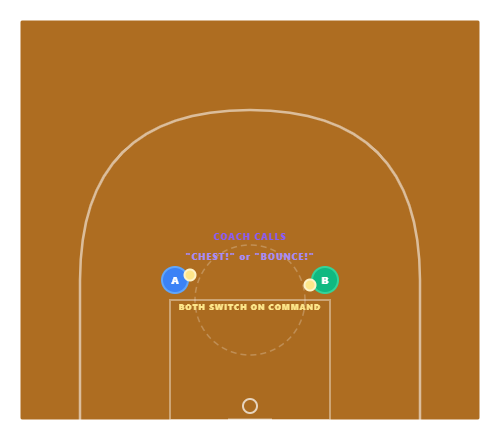
Reaction Calls : A coach or third player calls “SWITCH!” at random intervals. On the call, both players instantly swap their pass type — if you were chest-passing, switch to bounce-passing, and vice versa. This trains reactive decision-making while handling two balls. It simulates the split-second decisions of a real game where the defense shifts and you must adjust your pass type instantly.
Coaching Points
1 Eyes up — watch your partner, not the ball. Peripheral vision catches and throws.
2 The chest pass and bounce pass must arrive at the SAME time — synchronize your releases
3 When speed increases, accuracy matters MORE, not less. A fast bad pass is worse than a slow good one.
4 On reaction calls: the switch must be instant — no pause, no thinking. React and throw.
5 This drill builds the hand-eye coordination that separates passers from throwers
6 Two-ball drills should be done 3x per week minimum. Passing skill decays without constant reinforcement.
Processing Speed
Two-ball passing forces your brain to process two inputs and two outputs simultaneously. In a game, a point guard must see the defense, read the help, find the open man, and deliver the pass — all in under 1 second. Two-ball drills build the neural pathways for this multi-processing.
Coordination Foundation
Every D1 program runs two-ball passing in the first 10 minutes of practice. It’s a warm-up that doubles as skill development. Gonzaga, Duke, and Villanova all prioritize this drill. It’s the most efficient use of early-practice time.
5
Min
100+
Passes
1
Players
Solo
Type
High
Intensity
Passer Target● Ball
Rapid-Fire Wall Passes : Stand 8-10 feet from a wall. Chest-pass into the wall as fast as possible — the ball rebounds back, catch it, and immediately pass again. Goal: 50 passes in 30 seconds. This builds hand speed, catch-and-release timing, and grip strength. The wall never gives you a bad pass back — so the pace is entirely on you. Push the speed until your hands can barely keep up.
Passer Target● Ball
Alternating Targets : Mark two spots on the wall 4 feet apart. Alternate passing to the left spot and the right spot — chest pass left, chest pass right, left, right. This adds an accuracy component to the speed. You must redirect the ball to a different target on every rep while maintaining tempo. 30 seconds, then switch to bounce passes to the same two targets.
Passer Target● Ball
One-Hand Wall Passes : Right hand only — push pass into the wall, catch with both hands, push with the right hand again. 20 reps. Then left hand only — 20 reps. The wall forces you to generate power from ONE hand without the helper hand. This builds the one-hand push pass and wrap-around pass strength that you need in traffic and in the post. Your weak hand should match your strong hand’s speed by the end of 2 weeks.
Coaching Points
1 Wall passing is the BEST solo passing drill — you can do it alone, anytime, anywhere
2 Push the pace: if you’re comfortable, you’re going too slow. Find the speed where you start dropping passes, then train there.
3 Catch with soft hands — absorb the rebound, don’t fight it. Hard hands lead to fumbles.
4 On alternating targets: your eyes should find the target BEFORE the ball arrives in your hands
5 One-hand passes develop the wrap-around, the behind-the-back, and the cross-court skip — all advanced passes
6 Do 5 minutes of wall passing before every practice. Over a season, that’s 2,000+ extra passing reps.
Solo Development
Wall passing is the only high-quality passing drill you can do completely alone. No partner needed, no coach needed — just a ball and a wall. Players who do this on their own time develop faster than players who only pass during organized practice.
Hand Speed
The average college assist takes 0.7 seconds from decision to delivery. Wall passing at high speed trains your hands to operate at that pace — catch, redirect, release — in under a second. Slow hands miss passing windows. Fast hands create assists.
Half-Court Passing Drills
Passing within the structure of half-court offense — swing passes, skip passes, high-low feeds, and PnR reads. The passes that generate open shots and layups.
8
Min
40+
Passes
5
Players
Half Court
Type
Medium
Intensity
Passer Target● Ball
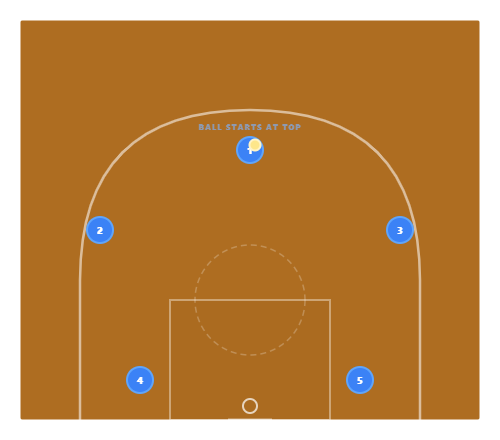
Setup : Five players in a shell alignment — point guard at the top, two wings, two corners. No defense. The ball starts with the point guard. The drill practices the three-pass sequence that breaks any zone or man defense: swing (top to wing), swing (wing to wing via reversal), and skip (cross-court to the opposite side). Every player must be able to execute every pass in the sequence.
Passer Target● Ball
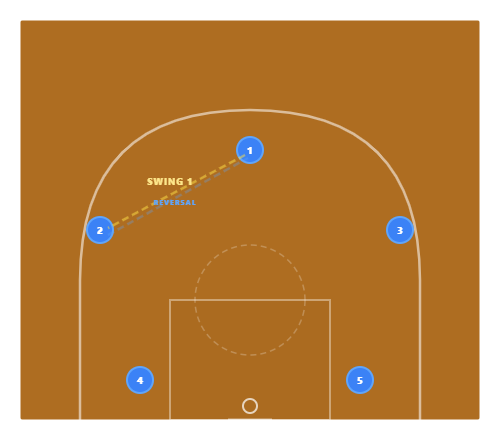
Swing Pass : 1 passes to 2 on the wing — a crisp chest pass or one-hand push. 2 catches and immediately looks inside (is the post open?). If not, 2 swings the ball back to 1. 1 swings to 3 on the opposite wing. The ball has now reversed sides — the defense is shifting. Each swing pass must be caught and delivered within 1 second. No holding the ball. Quick, crisp, purposeful.
Passer Target● Ball
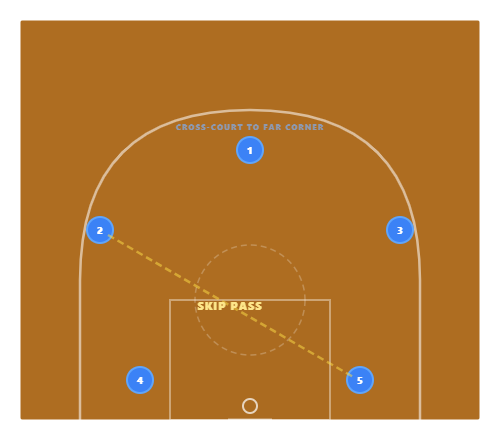
Skip Pass : Instead of swinging through the top, 2 throws a SKIP PASS directly to 5 in the far corner — a cross-court, over-the-top pass that travels the longest distance. The skip pass is the most devastating pass in zone offense because it goes over the entire defense in one throw. The pass must be high (over outstretched hands) and arrive on-target. 2 sets of full sequences (swing-swing-skip), then rotate positions.
Offense Defense● Ball
Skip Pass : Instead of swinging through the top, 2 throws a SKIP PASS directly to 5 in the far corner — a cross-court, over-the-top pass that travels the longest distance. The skip pass is the most devastating pass in zone offense because it goes over the entire defense in one throw. The pass must be high (over outstretched hands) and arrive on-target. 2 sets of full sequences (swing-swing-skip), then rotate positions.
Coaching Points
1 Every pass must be caught and released within 1 second — hold it longer and the defense recovers
2 The skip pass goes OVER the defense, not through it — aim high, throw with arc, hit the target in the chest
3 Receivers must show a hand target and be in their shooting stance BEFORE the ball arrives
4 Ball fakes are essential: fake high, pass low. Fake left, pass right. The eyes lead the defense.
5 Quick ball reversal (swing-swing) forces the defense to shift — that’s where open shots are created
6 After 2 sets without defense, add defenders. The drill only matters at game speed against real pressure.
Ball Movement = Wins
Teams that average 15+ assists per game in college basketball win 65%+ of their games. Swing-swing-skip is the foundational ball-movement pattern that generates those assists. It’s the first thing coaches teach in half-court offense — and the most important.
Zone Killer
The swing-swing-skip sequence is specifically designed to beat zone defenses. The swing makes the zone shift. The skip exploits the gap the zone leaves when it shifts. Every team that faces a 2-3 zone must run this pattern.
10
Min
30+
Passes
4-5
Players
Half Court
Type
High
Intensity
Offense Defense● Ball
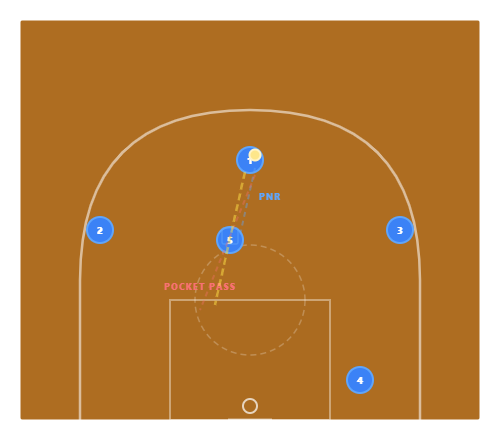
Pocket Pass (Roller) : 1 uses 5’s ball screen and drives. As 5 rolls to the basket, 1 delivers a “pocket pass” — a one-hand bounce pass into 5’s hip pocket area as they dive to the rim. The pocket pass goes UNDER the hedging defender and arrives in the roller’s hands for a layup. This is the #1 assist play in college basketball. Practice: 1 drives off the screen, 5 rolls, 1 hits the pocket. 10 makes from each side.
Passer Target● Ball
Kick-Out Pass (Shooter) : 1 drives off the PnR and draws the help defense. The corner or wing defender helps on the drive, leaving a shooter open. 1 kicks the ball out to the open shooter (3) for a catch-and-shoot three. The kick-out must be a snap pass — one hand or two hands, delivered instantly before the defense recovers. 10 reps from each side. The drive-and-kick is the highest-PPP play in basketball.
Passer Target● Ball
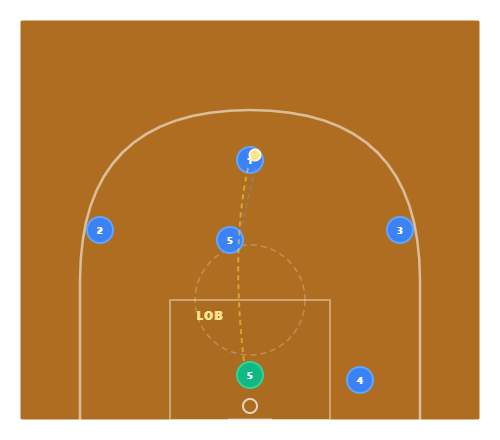
Lob Pass (Big Rolling) : 1 uses the screen. The defense drops — the big man’s defender sags deep to protect the rim. 5 rolls hard to the basket with their defender behind them. 1 throws a lob over the defense to 5 at the rim for a dunk or layup. The lob must have HIGH arc (over defenders) and soft touch (catchable at the rim). 10 reps. The PnR lob is the most exciting pass in basketball — and one of the most efficient.
Passer Target● Ball
Live Read : Add two defenders — one on the ball handler, one on the screener. Now 1 must READ the defense: if the big drops → pull-up or pocket pass. If the big hedges → reject and kick. If the big switches → attack the mismatch or lob. The defense varies their coverage randomly. 1 must make the correct read AND the correct pass. 10 reps, track decision quality AND pass accuracy.
Coaching Points
1 The pocket pass is a BOUNCE pass — never a chest pass to the roller. Chest passes get deflected.
2 On kick-outs: don’t wait to see if the shooter is open. Throw the pass as you see the help move — anticipate, don’t react.
3 The lob must be thrown EARLY — if you throw it late, the defender recovers and it’s a turnover
4 Ball fakes in the PnR: fake the pocket pass, then kick out. Fake the kick, then throw the lob. Eyes manipulate defenders.
5 Receivers must be ready before the pass: shooters in their stance, rollers with hands up
6 In the live read: if you make the wrong decision, stop and discuss why. Film study on the court.
PnR Dominance
The pick-and-roll generates ~45% of all half-court possessions in college basketball. The passer’s ability to read the defense and deliver the correct pass — pocket, kick, or lob — determines whether the PnR generates a layup, a three, or a turnover. Passing is the PnR.
Decision Speed
Elite college point guards make the PnR read in 0.5 seconds. They see the help, process the options, and deliver the pass before the defense can rotate. This drill builds that processing speed through thousands of live reps against real defenders.
8
Min
30+
Passes
4
Players
Half Court
Type
Medium
Intensity
Offense Defense● Ball
Setup : 5 is at the high post (free-throw line). 4 is on the low block. Guards are on the wings with the ball. The drill practices the high-low passing sequence: wing to high post, high post to low post. This inside-out-inside passing pattern is the most efficient way to score in the paint against man defense.
Passer Target● Ball
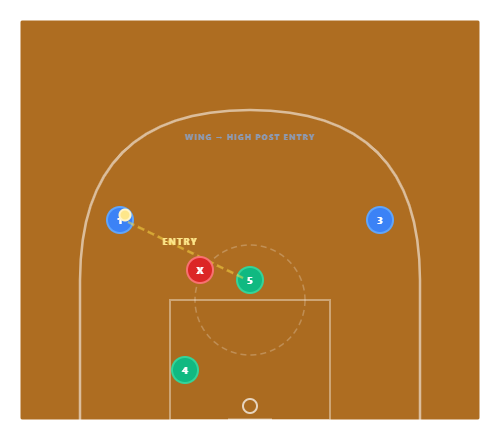
Wing to High Post : 1 passes to 5 at the high post. This is a chest pass or bounce pass around the defender. 5 catches facing the basket in triple threat. The key: 1 must FAKE before passing — look toward the basket, then pass to 5. The eye fake pulls the defender down, opening the passing lane to the high post. 5 catches with two feet planted and immediately looks LOW.
Passer Target● Ball
High to Low Feed : 5 catches at the high post and immediately delivers a bounce pass to 4 on the low block. This pass must go OVER or AROUND the low-post defender — 5 uses a ball fake (fake overhead, pass bounce) or a look-away pass to move the defender before delivering. 4 catches on the block for a power layup. 10 full sequences (wing → high → low), then switch sides.
Passer Target● Ball
Live Read : Add defenders on the high and low post. Now the passer must read: if the high-post entry is denied, skip to the opposite wing. If the high-low feed is denied, 5 kicks to the wing for a three. If 4’s defender fronts, 5 throws the lob over the top. The defense dictates the pass — the offense reacts with the correct read. 10 reps with live defense. Track assists AND turnovers.
Coaching Points
1 The high-post catch must be at the FREE-THROW LINE or above — too low and the high-low angle disappears
2 5 must catch facing the basket — pivot, see the floor, THEN decide. Don’t throw the ball blind.
3 Ball fakes at the high post: fake the overhead pass, then throw the bounce pass low. Misdirection is everything.
4 The low-post feed is almost always a BOUNCE pass — it goes under the outstretched arms of the defender
5 4 must seal their defender and show a target hand — give 5 a window to pass into
6 Timing: the high-low sequence should take under 3 seconds from wing entry to low-post catch. Any slower and the defense recovers.
Inside-Out-Inside
The high-low is the oldest and most effective play in basketball. Getting the ball inside forces the defense to collapse — and if they don’t collapse, you score in the paint. The high-low feed converts at ~60% when the catch is made on the block. There is no more efficient half-court play.
Who Runs It
North Carolina, Wisconsin, and Virginia have all built half-court offenses around the high-low feed. Any team with two skilled big men can use this action. It doesn’t require speed or athleticism — just precise passing and disciplined footwork.
Entry Pass Drills
Getting the ball inside — post entries, high-post feeds, and interior passing against denial defense. The hardest passes to make and the most valuable.
8
Min
25+
Reps
3
Players
Wing/Block
Zone
high
Intensity
Passer Post Defender
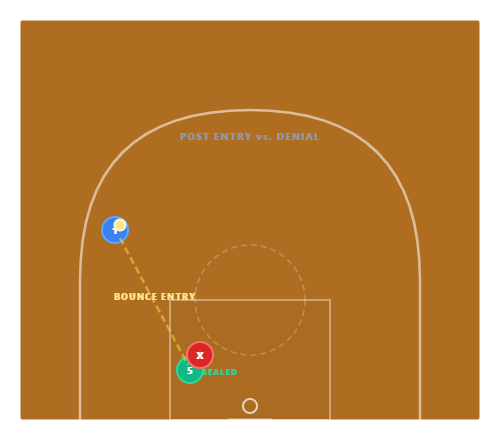
Bounce Entry Pass: The passer (1) is on the wing. The post player (5) is on the block with a defender fronting or three-quartering. 5 seals the defender on their back and shows a hand target on the hip. 1 delivers a bounce pass to 5’s target hand — the ball arrives below the defender’s reach. The bounce pass is the primary post entry because it goes UNDER the defense. 10 reps from each wing.
Passer Post Defender
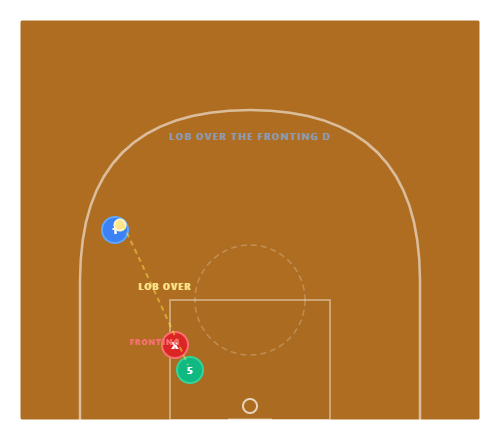
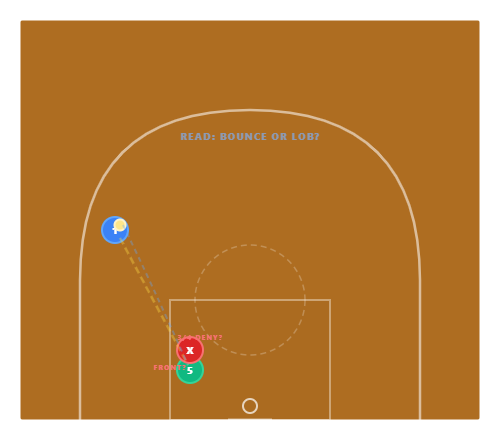
Lob Entry Pass : When the defender fronts (stands between the passer and the post), the lob pass goes OVER the top. 5 seals the defender on their chest and steps toward the basket. 1 throws a high, arcing lob to the rim-side of 5 — 5 catches and finishes. The lob entry punishes aggressive fronting defense. The pass must have enough arc to clear the defender but enough accuracy to land in 5’s hands. 10 reps each side.
Passer Post Defender
Live Read : The defender varies their denial — sometimes three-quartering (bounce entry is open), sometimes full fronting (lob is the play). The passer must READ the defender’s position and choose the correct pass. No coach call — the passer decides in real-time. 10 reps with the defender mixing coverages randomly. Track: correct reads AND accurate passes. Both matter.
Coaching Points
1 The post player must SEAL the defender and SHOW a hand target — give the passer a window
2 Bounce entry: aim for 5’s near hip. The pass arrives low, away from the defender.
3 Lob entry: throw to the RIM side, not the passer side. The lob goes OVER the defender, not around them.
4 The passer must use BALL FAKES before every entry: fake high, pass low. Fake bounce, throw lob.
5 If neither pass is available: DON’T FORCE IT. Reverse the ball and re-enter from the other side.
6 The post player must catch with two hands and chin the ball immediately — protect the entry.
The Hardest Pass
The post entry against denial defense is the hardest pass in basketball. The window is small (1-2 feet), the defender is active, and the consequence of a turnover is a steal-and-layup going the other way. Mastering this pass requires hundreds of reps against live denial.
Paint Touches
Teams that get 20+ paint touches per game score 8-12 more points than teams that don’t. The post entry is the primary way to get paint touches in half-court offense. If you can’t enter the ball inside, you can’t run half your offense.
8
Min
30+
Reps
3-4
Players
Elbow/Wing
Zone
High
Intensity
Passer Post Defender
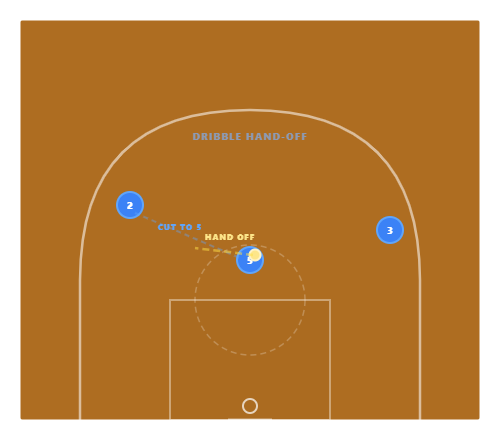
Basic DHO: 5 catches at the elbow and dribbles toward the wing. 2 cuts toward 5 for the dribble hand-off — 5 hands the ball directly to 2 as they pass each other. 2 receives the ball with momentum, attacking off the DHO. The hand-off must be CLEAN — 5 extends the ball into 2’s path, 2 takes it without breaking stride. 10 reps each side. The DHO is a ball screen and a pass combined into one action.
Passer Post Defender
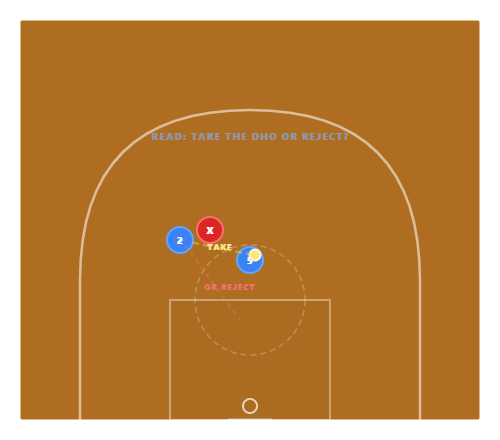
DHO Read : Add a defender on 2. If the defender goes OVER the DHO (stays on the outside) → 2 takes the handoff and attacks inside. If the defender goes UNDER (cheats inside) → 2 rejects the DHO and cuts backdoor for a pass from 5. The DHO becomes a read play — the defender’s position dictates 2’s action. 10 reps with the defender mixing coverages. This turns a simple handoff into a two-option play.
Passer Post Defender
DHO → Drive → Kick : 2 takes the DHO, drives into the paint, and kicks out to 3 or 4 on the opposite side for an open three. This is the full sequence: hand-off creates the advantage, the drive attracts the help, and the kick finds the open shooter. The kick pass must be a SNAP pass — one-hand push or two-hand chest, delivered the instant the help defender commits. 10 full sequences from each side.
Coaching Points
1 The hand-off must be CLEAN: 5 extends the ball at 2’s chest height into their path — not too high, not too low
2 2 must read the defender’s position BEFORE arriving at the DHO — the decision is made early, not late
3 On the rejection cut: 2 plants hard and cuts backdoor. 5 must see the rejection and deliver the pass.
4 The kick pass after the DHO-drive: throw it as the help defender’s feet leave the ground. That’s the window.
5 5 becomes a screener after the handoff — they seal the defender and roll to the basket as a second option
6 Timing: 2 should arrive at the handoff just as 5 extends the ball. Too early = collision. Too late = gap.
Guard-Big Connection
The dribble hand-off is the most common guard-big passing action in college basketball — used 10-15 times per game by most teams. It combines a screen, a pass, and a read into one fluid action. Gonzaga, Baylor, and Houston all run their offenses through DHO sets.
No Turnover Zone
The DHO should produce ZERO turnovers. It’s a hand-to-hand exchange at close range — the defense can’t steal what they can’t reach. If your team is turning the ball over on DHOs, the timing or the hand-off mechanics are broken. Fix the fundamentals.
Transition Break Drills
Full-speed outlet passes, numbered breaks, and secondary transition reads. Transition offense generates the most efficient scoring in basketball.
8
Min
20+
Reps
5
Players
Full Court
Zone
high
Intensity
Passer Post - - → Pass
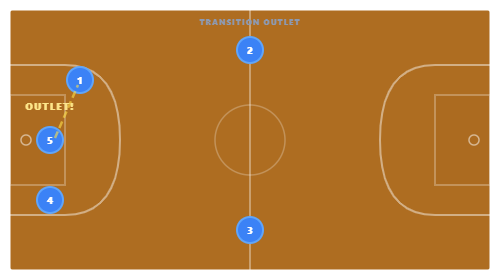
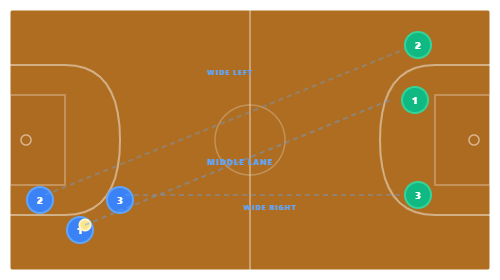
The Outlet Pass: 5 grabs the rebound, chins the ball, and immediately pivots to find 1 on the wing. The outlet pass is a one-hand baseball pass or a two-hand overhead pass — delivered within 1.5 seconds of the rebound. 1 catches on the run and pushes the ball up the floor. The outlet is the ignition of the fast break — slow outlets kill transition opportunities. 10 reps from each side of the court.
Passer Post - - → Pass
3-Lane Fill : On the outlet, three players sprint to fill three lanes — the middle (ball handler), and both wings. The ball handler pushes up the center of the floor. The wings sprint wide, touching the sidelines. All three players must run at 100% — the break only works at full speed. Arrive at the offensive end in a triangle: ball in the middle, shooters on the wings.
Passer Post - - → Pass
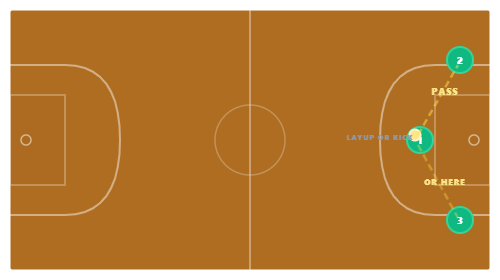
Finish the Break : At the offensive end, 1 attacks the rim. If the lane is open → layup. If a defender steps up → kick to 2 or 3 on the wing for an open three. The decision is simple: open lane = score. Help defense = pass. 5 reps finishing with the layup, 5 reps finishing with the kick-out. The transition break should generate a layup or an open three — anything else is a failed break.
Coaching Points
1 The outlet must happen within 1.5 seconds of the rebound. Every half-second of delay kills the break.
2 The ball handler pushes the MIDDLE of the floor — never the sideline. The middle gives you passing angles to both sides.
3 Wings sprint WIDE — touch the sideline. Wide lanes stretch the defense and create driving lanes.
4 Head up while dribbling in transition — see the floor. Down-ball dribbling misses open teammates.
throw lob.
5 The layup is always the FIRST option. Only kick out if the lane is blocked. Don’t over-pass.
6 Sprint through the play — don’t slow down at half court. Full speed from the rebound to the finish.
Transition Efficiency
Transition offense scores ~1.2-1.4 PPP — 25-40% more efficient than half-court offense (~1.0 PPP). Every fast-break possession your team creates is worth significantly more than a half-court set. The outlet pass is the single most valuable pass in basketball because it starts this sequence.
Program Identity
Programs like Arkansas (40 Minutes of Hell), VCU (Havoc), and North Carolina (secondary break) build their entire identity around transition. These teams out-score opponents by 8-12 points per game in transition alone. The outlet-and-fill drill is the foundation of their system.
10
Min
20+
Reps
5
Players
Full Court
Zone
Very High
Intensity
Passer Post - - → Pass
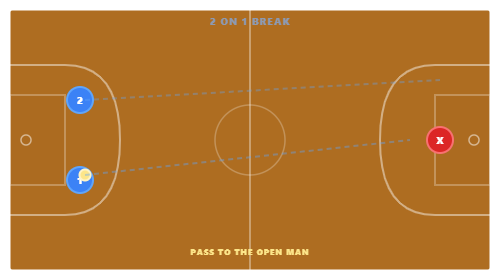
2-on-1: Two offensive players vs. one defender. The ball handler attacks. If the defender commits to the ball → pass to the open wing for a layup. If the defender drops to take away the pass → the ball handler scores. This is the simplest transition read: pass or score? 10 reps. The pass must be made BEFORE the defender can recover — anticipate, don’t wait for them to commit fully.
Passer Post - - → Pass
3-on-2 : Three offensive players vs. two defenders in tandem (one up, one back). 1 attacks the top defender. If the top defender stops the ball → 1 passes to the open wing. The back defender must choose which wing to cover — the other wing is open. Two passes maximum to generate a layup. This is the most common transition situation in college basketball. 10 reps from each side.
Passer Post - - → Pass
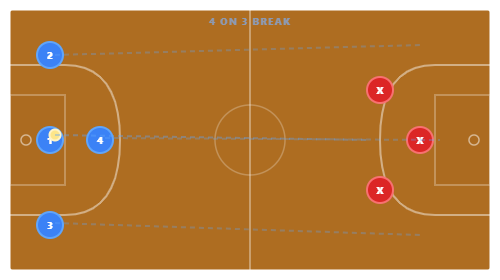
4-on-3 : Four offensive players vs. three defenders. This is the “secondary break” situation — the initial 3-on-2 wasn’t scored, but a trailer arrives to create a 4-on-3 advantage. The extra man is usually a big who trails the play. The ball handler reads: attack the gap, pass to the open wing, or hit the trailing big for a mid-range or three. 10 reps. The 4-on-3 is the most complex transition read — it requires seeing all four options simultaneously.
Passer Post - - → Pass
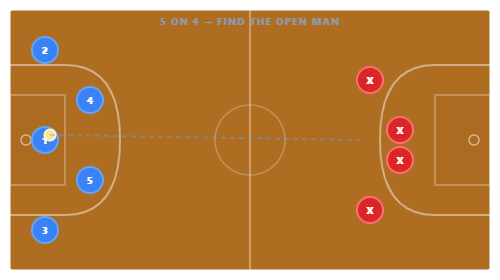
5-on-4 / 5-on-0 : Full team transition break. The fifth player arrives — often a big running the floor late. Now it’s 5-on-4 or 5-on-0 if the defense hasn’t gotten back. The ball handler must find the open man as quickly as possible — the advantage is temporary. The golden rule: get the ball to the most advantageous position in 2 passes or fewer. Any more and the defense recovers. 5 full-speed reps.
Coaching Points
1 Every numbered break has the same rule: LAYUP FIRST. If the layup is available, take it. Don’t over-pass.
2 Maximum 2 passes in transition. The third pass means the defense has recovered — go to half-court offense.
3 The ball handler’s eyes must be UP — see the whole floor. A ball handler who looks at the floor wastes the advantage.
4 Wings run WIDE and fill to the corners. Corners create the widest possible driving lanes for the ball handler.
5 The trailer (4th or 5th player) runs to the TOP of the key — not the wing. The trailer three is one of the most efficient shots in basketball.
6 Every rep at full speed. Walking through transition drills is pointless — the whole advantage is speed.
Numbered Break System
The numbered break system (2-on-1, 3-on-2, 4-on-3, 5-on-4) teaches players to read the advantage and score at each level. If you can’t score 2-on-1, you can’t score 3-on-2. Master each level before moving to the next. The progression builds complete transition IQ.
Trailer Threes
The trailer three — the 4th or 5th player catching at the top of the key for an open three — converts at ~40% in college basketball. It’s one of the most efficient shots available because the defense is scrambling and no one picks up the trailer. Great transition teams get 4-6 trailer threes per game.
Press Break Passing
Passing under full-court pressure — inbound passes against denial, outlet passes under traps, and the decision-making that beats any press.
8
Min
20+
Reps
5+
Players
Full Court
Zone
high
Intensity
Offense Press D
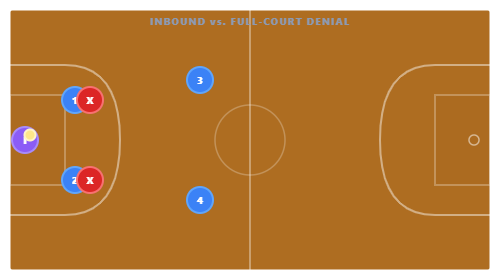
Setup: Inbounder (I) is on the baseline after a made basket. Two guards are near the ball, being denied by two aggressive defenders. Two more players are at half court or beyond. The defense is in full-court denial — no easy inbound. The drill practices getting the ball in against pressure — the first and most critical pass of any press break.
Offense Press D
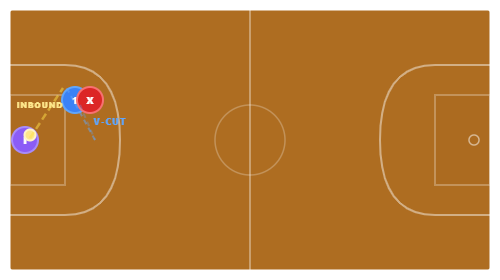
V-Cut to Get Open: 1 cuts TOWARD the ball (V-cut) — takes two hard steps toward the inbounder, then plants and cuts AWAY from the defender at a 45-degree angle. The change of direction creates separation. The inbounder hits 1 on the cut. The V-cut must be sharp: 2 steps in, hard plant, explosive cut out. Lazy V-cuts don’t create separation. 10 reps from each side.
Offense Press D
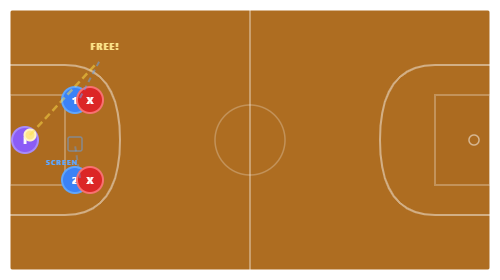
Back Screen Inbound : 2 sets a back screen on 1’s defender. 1 cuts off the screen and sprints up the sideline — wide open. The inbounder hits 1 in stride. This is the primary press-break action when straight V-cuts are being denied: use a teammate’s screen to free the receiver. After the inbound, 2 pops back as the safety outlet. 10 reps with the screen from each side.
Offense Press D
Long Inbound : If both guards are denied, the inbounder looks DEEP — 3 is cutting up the sideline at half court. The inbounder throws a baseball pass over the press to 3 in stride. This is the “home run” pass that punishes aggressive denial. The pass must be accurate and on-target — a bad long pass is a turnover. But a good one beats the entire press in one throw. 10 reps.
Coaching Points
1 The inbounder has 5 seconds — use the first 2 to survey, then deliver. Don’t rush and don’t panic.
2 V-cuts must be SHARP: two hard steps in, plant, explode out. Lazy V-cuts get jumped.
3 Back screens on the inbound are legal and devastating — use them when denial is aggressive
4 The long pass is a baseball pass: step, throw over the top, put the ball 2 feet in front of the runner
throw lob.
5 The inbounder must FAKE: look one direction, pass the other. Eye fakes move defenders.
6 Never throw the ball into a crowd. If nothing is open, call timeout. A 5-second violation is better than a turnover-and-layup.
The 5-Second Battle
The inbound pass against full-court denial is a 5-second battle of wits. The inbounder has 5 seconds to find an open teammate against aggressive denial. The best inbounders use fakes, misdirection, and patience to find the open man — just like a quarterback reading coverage.
Turnover Prevention
Press-break turnovers are the most costly turnovers in basketball — they lead directly to layups going the other way. A team that loses 4-5 possessions to the press gives up 8-10 easy points. Press-break passing drills prevent these catastrophic turnovers.
8
Min
20+
Reps
5
Players
Full Court
Zone
Very High
Intensity
Offense Press D
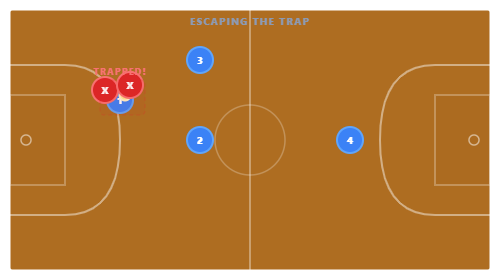
The Trap Situation: 1 catches the inbound and is immediately double-teamed on the sideline. Two defenders collapse on the ball. 1 is pinned between two defenders and the sideline. This is the most common press trap: the ball handler catches, and two defenders sprint to create a 2-on-1 trap. The drill teaches 1 how to ESCAPE the trap without turning the ball over.
Offense Press D
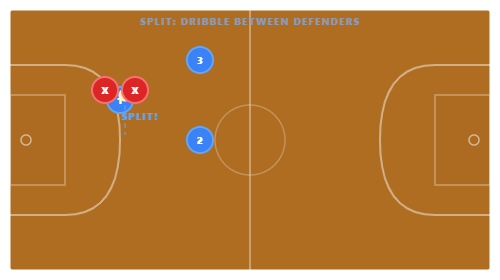
Split the Trap : If the two defenders leave a gap between them, 1 dribbles THROUGH the gap (the “split”). This is the most aggressive escape — you dribble right through the trap. The key: attack the gap before it closes. The moment you see daylight between the two defenders, put your head down and push through. If the gap closes, don’t force it — use another escape. 5 reps where the defenders leave the gap, 5 where they close it.
Offense Press D
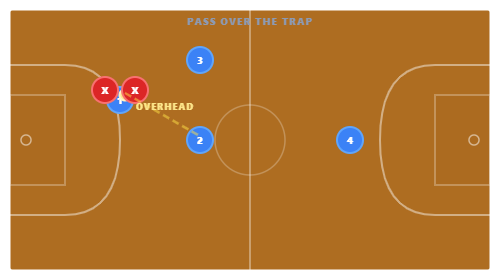
Overhead Pass Out : If the trap is tight (no gap), 1 pivots, protects the ball, and throws an overhead pass to the nearest open teammate (2). The overhead pass goes ABOVE the defenders’ outstretched hands. 1 must pivot to create an angle, then throw with two hands — high arc, crisp delivery. 2 catches and immediately advances the ball. The pass must be made within 2 seconds of the trap — any longer and the interceptors arrive.
Offense Press D
Reverse Pivot Escape : 1 reverse pivots (spins away from the trap) to create a new passing angle. This puts 1’s body between the trap and the ball — protecting it. From the reverse pivot, 1 can pass to 2 (near outlet) or 3 (deep outlet). The reverse pivot is the safest escape because it protects the ball and creates vision up the floor. 10 reps with the defense trapping at full intensity. This is the most important press-break skill.
Coaching Points
1 Stay CALM in the trap. Panic turnovers are the #1 result of full-court pressure. Breathe.
2 Protect the ball: keep it at chin level, elbows out. Don’t expose the ball to the trap.
3 The reverse pivot creates a new passing angle and protects the ball simultaneously — it’s your best friend
4 NEVER pick up your dribble in the trap unless you have a pass to make. Live dribble = options. Dead ball = trapped.
5 The overhead pass goes OVER the trap — not through it and not around it. Aim high.
6 Teammates must CUT TOWARD the ball when 1 is trapped — don’t stand and watch. Come help.
Trap Survival
The most common turnover in college basketball is the trap-induced bad pass. When two defenders collapse on the ball, the ball handler panics and throws it away. This drill trains CALM under pressure — the ability to stay composed, protect the ball, and find the right pass when the defense is at its most aggressive.
Teammate Responsibility
When the ball handler is trapped, it’s not just their problem — teammates must cut toward the ball, provide passing outlets, and CALL for the ball. Press-break passing is a 5-player skill. The ball handler escapes the trap; the teammates create the escape routes.
By the Numbers
How passing impacts winning at the college level — assist rates, turnover margins, and the efficiency of ball movement.
Transition PPP
1.2-1.4
Half-Court PPP
0.9-1.0
Assist Rate (Elite)
58-64%
Assist Rate (Average)
48-52%
TO per Game (Bad)
10-12
TO per Game (Bad)
15-18
Paint Touches → PPP
1.3+
16% Turnover Gap
Unprepared teams turn it over ~28% against press defense. Teams that drill press breaks cut that to ~12%. That's 5–6 fewer turnovers per game — often the margin between winning and losing.
1.22 PPP Goldmine
Breaking the press creates transition opportunities worth ~1.22 points per possession — among the highest-efficiency situations in basketball. The press is a gamble, and when it fails, you should make them pay.
The Fatigue Factor
Press teams expend massive energy. If you break the press consistently through the first half, the pressing team's defense degrades significantly in the second half. Patience beats pressure.
10-Second Killers
About 15% of turnovers against press defense are 10-second violations or backcourt traps — not steals. Simply advancing the ball calmly eliminates a huge chunk of press-caused turnovers.